From Awareness to Action: What Evidence Tells Us About Preventing Gender-Based Violence
Share:


Reflections for the 16 Days of Activism from More Than Two Decades of Prevention Work
Every year, the 16 Days of Activism Against Gender-Based Violence reminds us of a sobering reality: violence against women and girls remains one of the most widespread human rights violations globally. This year’s UNiTE campaign theme, “Ensure Justice, Protect Survivors, End Impunity,” 16 days of Activism yearly theme calls on governments, institutions, communities and practitioners to strengthen prevention efforts, improve survivor access to justice and support services, and hold perpetrators accountable.
Across more than two decades of GBV prevention programming and research, I have worked alongside communities, governments, researchers, practitioners and young people navigating the realities of poverty, conflict, displacement, harmful social norms and gender inequality. If there is one lesson these experiences have taught me, it is this: awareness is important, but awareness alone does not end violence.
Most people already know that violence is wrong.
The challenge is transforming the unequal power relations, harmful gender norms and social expectations that allow violence to persist across generations. As we mark this year’s 16 Days of Activism, it is worth reflecting not only on the scale of gender-based violence (GBV), but also on what evidence increasingly tells us works to prevent it.
Photo:
Violence Does Not Occur in Isolation
Violence against women and girls does not occur in a vacuum. It is shaped by a complex interaction of unequal power relations, discrimination, economic insecurity, harmful gender norms, conflict, disability, age, displacement and other forms of social exclusion.
Effective prevention requires us to understand these intersecting realities and the ways they influence risk, access to services and opportunities for change.
At Save the Children, understanding violence starts with understanding power. Resources such as our Gender and Power Analysis Guidance help practitioners explore how age, gender, disability, poverty and other intersecting identities shape experiences of violence, exclusion and access to services. Complementing this, our Ethics and Methods for GBV Data Collection Guidance supports survivor-centred, ethical and participatory approaches to evidence generation, ensuring that research prioritises safety, dignity and meaningful participation.
These resources remind us that understanding violence is not simply about collecting data. It is about understanding the systems, inequalities and social norms that sustain it. Effective prevention must therefore go beyond responding to incidents of violence and address the root causes that allow violence to persist.

Gender & Power (GAP) Analysis Guidance
2021 · Save the Children
Save the Children’s Gender and Power (GAP) Analysis Guidance is an essential tool to examine, understand, and address discrimination and inequality that prevent children, their... View Full Abstract
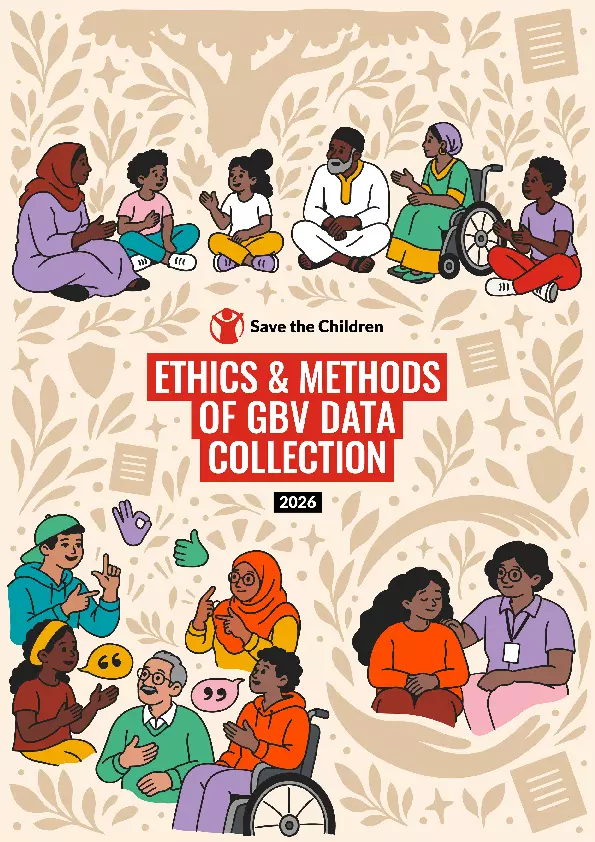
Ethics & Methods of GBV Data Collection (2026)
2026 · Save the Children International
Before diving into this guidance, we encourage readers to spend a few minutes with the Introduction. It explains why ethical and survivor-centred GBV data collection matters, the... View Full Abstract
Changing Norms Means Working with Communities
Lasting change happens when communities become active agents of transformation rather than passive recipients of messages.
Across Save the Children’s work, community dialogue, social and behaviour change, participatory learning and community mobilisation approaches create opportunities for women, men, girls and boys to reflect on the beliefs, attitudes and expectations that shape everyday life.
Evidence-based approaches such as VOICES, CHOICES, and PROMISES support communities to explore issues of gender, power, relationships, caregiving and equality while creating pathways for collective action and lasting social norms change. These approaches recognise that change is most sustainable when it is owned and driven by communities themselves.
The lesson is simple but powerful: social norms change when communities lead the process of transformation.

Choices, Voices, Promises: Creating equality for very young adolescents by shifting gender norms
2017 · Save the Children
This document summarizes a gender transformative package of interventions called Choices, Voices, and Promises, which works across society to accomplish positive social and... View Full Abstract
Photo:
Men and Boys Are Part of the Solution
One of the most significant advances in violence prevention has been the growing evidence that engaging men and boys’ matters.
This is not about shifting attention away from women and girls. Rather, it reflects an important reality: gender equality cannot be achieved through women’s empowerment alone.
Gender-transformative approaches encourage men and boys to reflect on power, masculinity, caregiving, relationships and non-violent ways of engaging with partners, families and communities. Global evidence, including findings from Boys Engage, demonstrates that thoughtfully engaging boys and young men can contribute to more equitable attitudes and behaviours.
Programmes such as REAL Fathers and Safe Families build on this evidence by supporting fathers, male caregivers and couples to challenge harmful norms, strengthen caregiving practices and promote equitable relationships within households and communities.
Evidence has shown improvements in shared decision-making, increased father involvement in caregiving, stronger family relationships, and reductions in violence against both women and children. Importantly, this work is not about blaming men. It is about creating opportunities for men and boys to become allies and partners in building safer, more equitable communities.
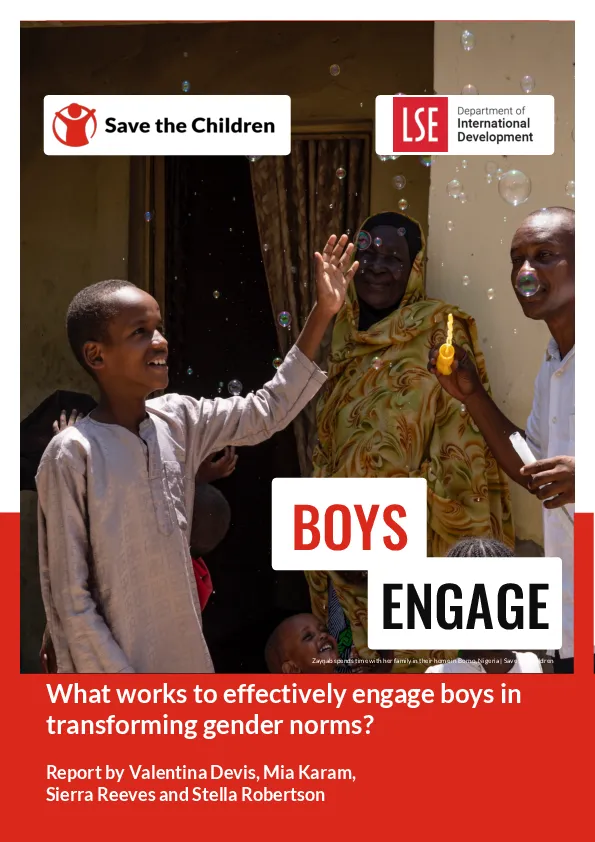
Boys Engage: What works to effectively engage boys in transforming gender norms
2025 · LSE, London School of Economics
Save the Children UK together with the London School of Economics have undertaken research to create an evidence base on what works to effectively engage with boys across our... View Full Abstract

Real Fathers Initiative
2013 · Save the Children US
This document presents the Responsible, Engaged and Loving (REAL) Fathers Initiative. This initiative was created with the primary objective to develop and test a set of... View Full Abstract

Safe Families Common Approach 2-Pager Brief
2023 · Save the Children International
Save the Children’s Safe Families approach is a universal preventative programme for use in development and humanitarian contexts to reduce physical and humiliating... View Full Abstract
Evidence Must Guide Action
A critical lesson from more than two decades of GBV prevention is that not all data needs to be collected simply because it can be collected.
As practitioners and researchers, we must continually ask ourselves: What information is needed? Who will benefit from collecting it? Could the process place participants at risk? Does the information already exist elsewhere?
Save the Children’s Ethics and Methods for GBV Data Collection Guidance reminds us that good evidence is not defined by the quantity of data collected, but by whether the information collected is necessary, useful, ethical and safe.
High-quality evidence helps us understand what works, for whom, and under what conditions. It enables programmes to adapt, improve and scale while remaining accountable to the people they serve. Across Save the Children’s work, evidence continues to shape programmes that prevent violence, promote gender equality and strengthen protection systems.
Photo:
Looking Forward
Ending gender-based violence requires more than awareness campaigns. It requires long-term investment in prevention, community leadership, stronger systems, meaningful inclusion, survivor-centred services and evidence-based approaches that address the root causes of violence.
The encouraging news is that we know more today about what works to prevent violence than ever before. The evidence is clear: transforming harmful gender norms, engaging communities, supporting women and girls, working with men and boys, and strengthening systems can contribute to meaningful and lasting change.
The challenge before us is not a lack of solutions. It is our willingness to invest in them, adapt them, scale them and sustain them.
As we mark this year’s 16 Days of Activism, let us move beyond awareness and commit to action that transforms norms, shifts power, strengthens systems and accelerates progress towards a world free from violence for every woman, girl and child.
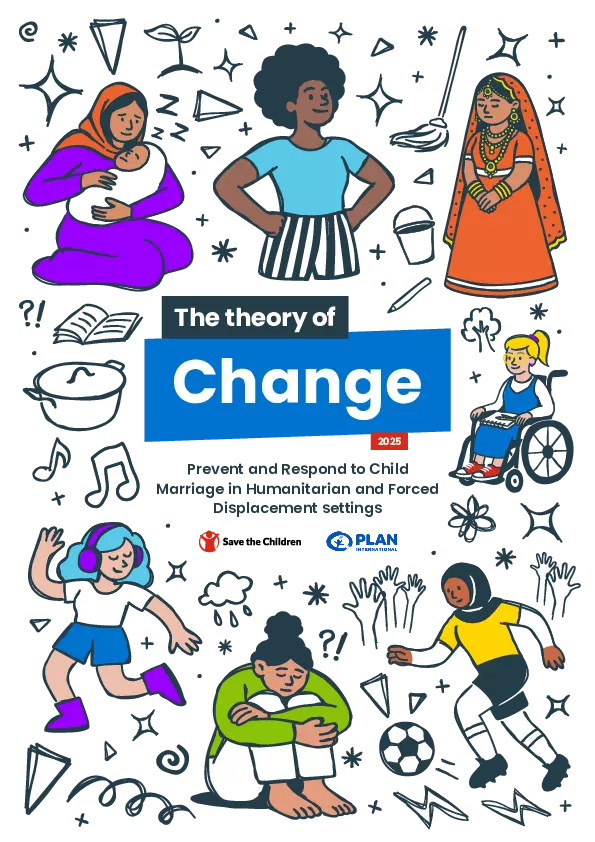
The Theory of Change to Prevent and Respond to Child Marriage in Humanitarian and Forced Displacement Settings (2025)
2025 · Plan International
Crises are increasing the likelihood of child marriage for girlsChild marriage is a violation of human rights that disproportionately affects adolescent girls. It is both a form of... View Full Abstract

Preventing and Responding to Child, Early, Forced Marriage and Unions Technical Guidance 2021
2021 · Save the Children International
Child, early, forced marriage and unions (CEFMU) is a severe violation of human rights and results in threats to children’s immediate and long-term wellbeing. As a child... View Full Abstract

Toward an End to Child Marriage: Lessons from research and practice in development and humanitarian sectors
2018 · Save the Children International
While child marriage has been on the decline recent decades, there is a growing concern for its increased prevalence in crisis situations during conflict and natural disasters. The... View Full Abstract
Photo:
Explore Related Resources
To learn more about Save the Children’s evidence and approaches on gender equality, social norms change and violence prevention, explore:

Save the Children Gender Equality Program Guidance and Toolkit: Engendering transformational change
2014 · Save the Children
Gender equality is inextricably linked to child rights, and around the world gender discrimination results in critical child rights violations. As Save the Children, it is... View Full Abstract
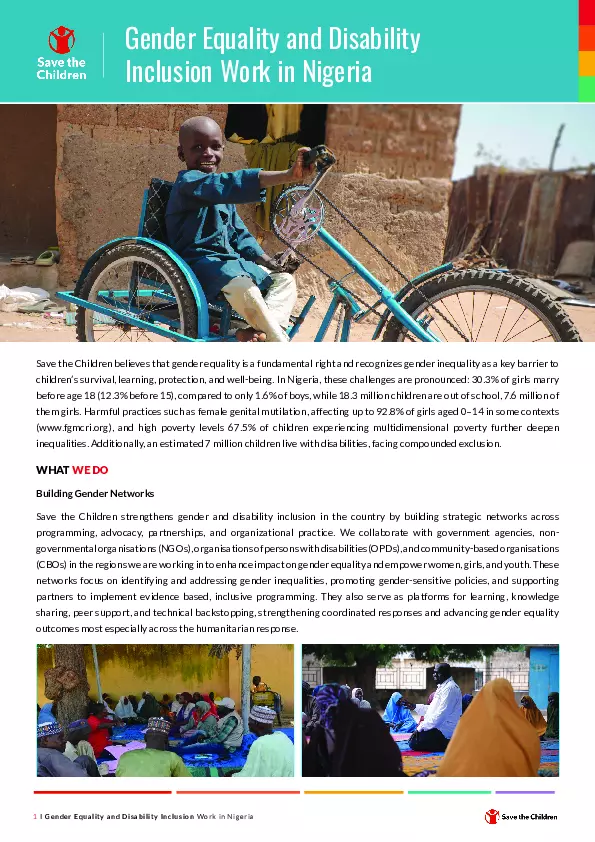
Technical Brief: Gender Equality and Disability Inclusion in Nigeria (2026)
2026 · Save the Children Nigeria
This brief highlights Save the Children Nigeria’s work to advance gender equality and disability inclusion through gender-transformative and inclusive programming. Key approaches... View Full Abstract
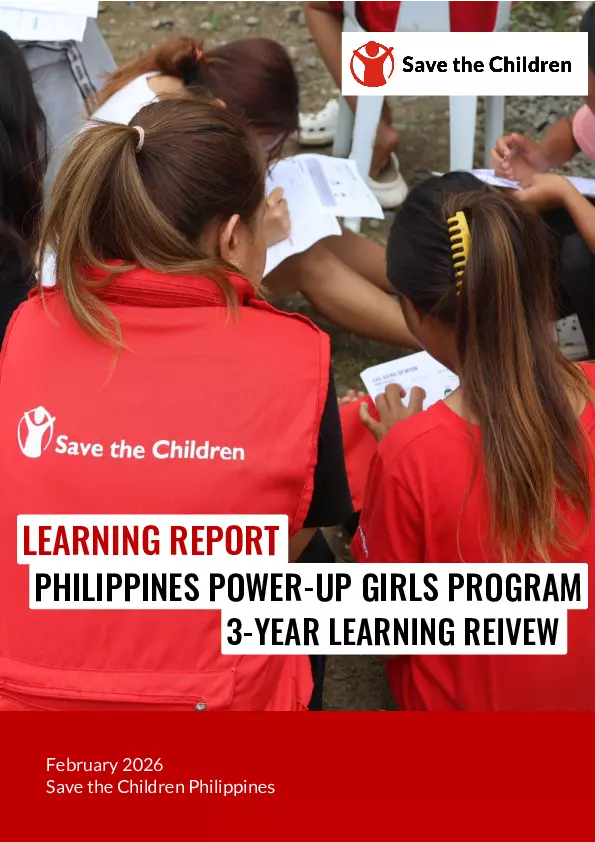
Learning Report: Philippines Power-Up Girls Program 3-Year Learning Review (2026)
2026 · Save the Children Philippines
Adolescent girls in marginalized communities in the Philippines continue to face serious risks, including early pregnancy, child marriage, discrimination, and limited opportunities... View Full Abstract
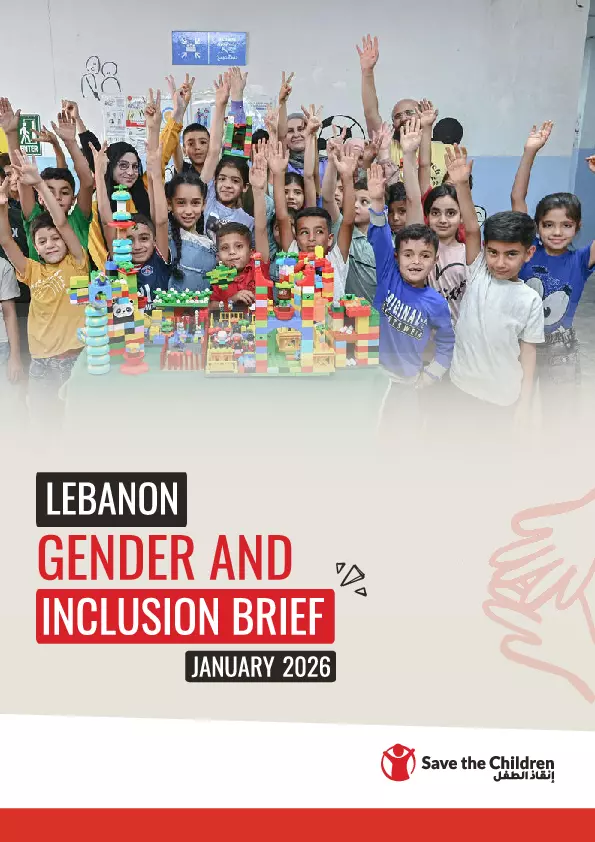
Lebanon: Gender and Inclusion Brief
2026 · Save the Children Lebanon
This brief examines the compound impacts of Lebanon’s ongoing crises—including economic collapse, conflict, and displacement—on gender equality and social inclusion, with a... View Full Abstract

Towards a Gender Just Future: The role of gender programming in advancing gender equality in Somalia
2024 · Save the Children International
This report explores Save the Children Somalia’s comprehensive approach and our progress towards gender equality for all in Somalia especially women, and girls. it highlights... View Full Abstract

Share
Link