
Study: Research
Understanding the Gender and Power Influences Regarding Access to MNH and SRHR Services: A Qualitative Study at Selected Rural Areas of Rangpur, Bangladesh (2025)

Publication year:
2025

English

Format:
(223.2 KiB)

Publisher:
Science and Education Publishing
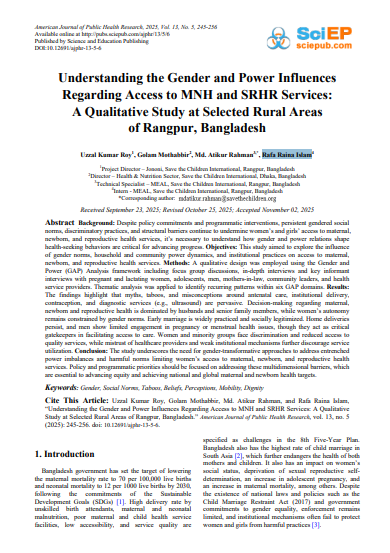
Background: Despite policy commitments and programmatic interventions, persistent gendered social norms, discriminatory practices, and structural barriers continue to undermine women’s and girls’ access to maternal, newborn, and reproductive health services, it’s necessary to understand how gender and power relations shape health-seeking behaviors are critical for advancing progress.
Objectives: This study aimed to explore the influence of gender norms, household and community power dynamics, and institutional practices on access to maternal, newborn, and reproductive health services.
Methods: A qualitative design was employed using the Gender and Power (GAP) Analysis framework including focus group discussions, in-depth interviews and key informant interviews with pregnant and lactating women, adolescents, men, mothers-in-law, community leaders, and health service providers. Thematic analysis was applied to identify recurring patterns within six GAP domains.
Results: The findings highlight that myths, taboos, and misconceptions around antenatal care, institutional delivery, contraception, and diagnostic services (e.g., ultrasound) are pervasive. Decision-making regarding maternal, newborn and reproductive health is dominated by husbands and senior family members, while women’s autonomy remains constrained by gender norms. Early marriage is widely practiced and socially legitimized. Home deliveries persist, and men show limited engagement in pregnancy or menstrual health issues, though they act as critical gatekeepers in facilitating access to care. Women and minority groups face discrimination and reduced access to quality services, while mistrust of healthcare providers and weak institutional mechanisms further discourage service utilization.
Conclusion: The study underscores the need for gender-transformative approaches to address entrenched power imbalances and harmful norms limiting women’s access to maternal, newborn, and reproductive health services. Policy and programmatic priorities should be focused on addressing these multidimensional barriers, which are essential to advancing equity and achieving national and global maternal and newborn health targets.
Read full abstract
Authors


View & Download


Document information
Publisher
Content type
Country
Region
Topics
Rights
© Author/Publisher
Found a mistake? Help us improve!
If you have noticed a document assigned to the wrong author or any other inaccuracies, let us know! Your feedback helps us keep our data accurate and useful for everyone.
 Subscribe and receive reading selections
 Save all your favorite materials for future use
 Upload research & contribute to the collection
Share

Link