
Study: Research
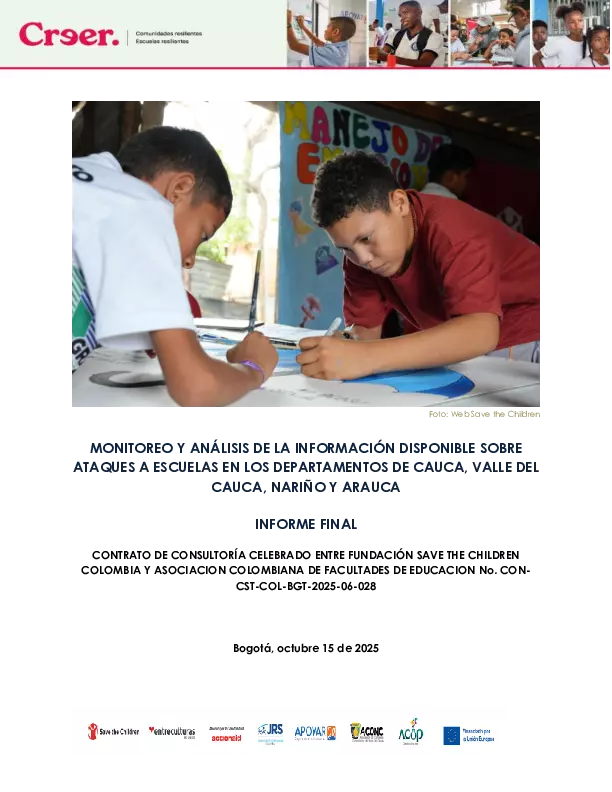
Monitoring and Analysis of Available Information on Attacks on Schools in the Departments of Cauca, Valle del Cauca, Nariño, and Arauca (Colombia, 2025)

Publication year:
2025

Spanish

Format:
(3.2 MiB)

Publisher:
Save the Children Colombia
This technical report consolidates the results of monitoring and analyzing attacks on schools in Colombia during the period from January 2024 to August 2025, in the departments of Cauca, Nariño, Valle del Cauca, and Arauca—territories prioritized due to their high exposure to armed conflict and humanitarian risk.
The study was developed within the framework of a consultancy agreement between Save the Children Colombia and the Colombian Association of Faculties of Education (ASCOFADE), with the purpose of strengthening evidence generation and data-driven decision-making regarding the protection of the right to education.
The monitoring system combines open data analysis technologies, artificial intelligence tools, natural language processing (NLP), and dynamic visualization platforms using Python, Google Colab, and Power BI. Based on institutional and journalistic sources, a georeferenced, refined, and traceable database was built, enabling the examination of the evolution of attacks, their territorial distribution, and the affected populations.
The model classifies events into verifiable categories: attacks on schools, threats, military use of educational facilities, forced recruitment, confinements, displacements, and impacts from explosive devices, among others. Each record retains the original source and its geographic location, ensuring transparency, methodological consistency, and auditability.
Monitoring attacks on schools in Colombia between 2024 and August 2025 reveals a sustained increase in incidents affecting educational security in the departments of Cauca, Nariño, Valle del Cauca, and Arauca, shaping a structural risk scenario for children, adolescents, teachers, and educational communities.
The study, based on analysis of official sources and media reports, uses Python, Google Colab, and Power BI tools to build a traceable and georeferenced database that allows visualization of territorial, thematic, and population patterns.
Read full abstract
View & Download

Spanish
9 Documents


Document information
Publisher
Content type
Country
Region
Rights
© Author/Publisher
Found a mistake? Help us improve!
If you have noticed a document assigned to the wrong author or any other inaccuracies, let us know! Your feedback helps us keep our data accurate and useful for everyone.
 Subscribe and receive reading selections
 Save all your favorite materials for future use
 Upload research & contribute to the collection
Share

Link