
Publication year:
2026

English

Format:
(3.5 MiB)

Publisher:
Save the Children International
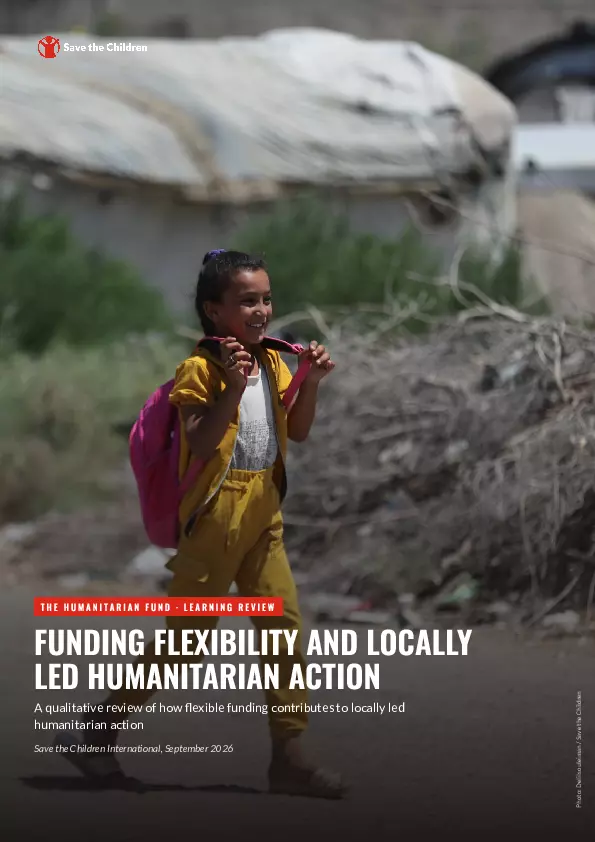
This learning review examines how flexible funding from Save the Children’s Humanitarian Fund (HF) contributes to locally led humanitarian action. The review team conducted 23 interviews with 29 Country Office staff and local and national partners across eight country contexts, covering both the Locally Led Humanitarian Action Window and regular HF allocations.
Participants linked flexible funding to faster, more relevant and more adaptive humanitarian responses. Partners reported stronger management systems, greater credibility with donors and governments, and new funding and leadership roles in coordination structures. Trust between Country Offices and partners proved the strongest enabler, and indirect cost recovery (ICR) helped local organisations build resilience beyond the grant period.
The review also identifies limits. Country Offices cascaded flexibility to partners in part, and partners experienced less of it than Country Office staff believed they had passed on. Contracting, approval and compliance processes constrained partner-led ways of working, and decision-making became more collaborative without a full transfer of power.
The report sets out nine recommendations for the HF, Save the Children and the wider sector, including clearer guidance on flexibility, proportionate risk management, ICR as a strategic investment, and measuring shifts in decision-making authority alongside funding flows.
Read full abstract


Publisher
Authors
Content type
Country
Rights
© Author/Publisher
If you have noticed a document assigned to the wrong author or any other inaccuracies, let us know! Your feedback helps us keep our data accurate and useful for everyone.
 Subscribe and receive reading selections
 Save all your favorite materials for future use

Share

Link



 Upload research & contribute to the collection