
Best Practices/Lessons Learned, Study: Evaluations
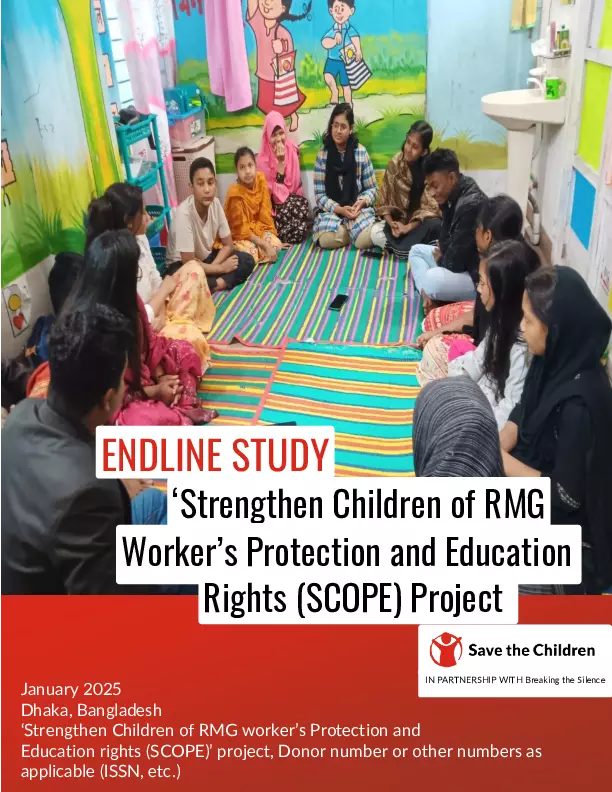
Endline Evaluation Report: Strengthen Children of RMG Workers’ Protection and Education Rights (SCOPE) Project (Bangladesh, 2025)

Publication year:
2025

English

Format:
(1.8 MiB)

Publisher:
Save the Children Bangladesh
The endline evaluation of the SCOPE project aimed to determine the extent to which the project achieved its intended outcomes in child protection, education, and family support for RMG worker communities in Dhaka and Savar. The study employed a mixed-methods design, integrating quantitative tools (CREDI, IDELA, STEM assessments) and qualitative methods (FGDs, KIIs, case studies) under a Convergent Parallel framework.
Key findings include a significant increase in children’s protection from violence (from 31.44% at baseline to 92.95% at endline), improved grade-level competency in Math and Science (over 85% scores compared to baseline averages of 35–48%), and enhanced early childhood development across cognitive, language, and socio-emotional domains. STEM education reached 47.2% of targeted adolescents, with a 97.4% completion rate, and life skills training improved problem-solving and decision-making abilities among 93.5% of participants.
Caregiver knowledge on child rights and positive parenting rose by over 50 percentage points, while community leaders demonstrated a 39% increase in awareness of child rights and gender inclusion. The evaluation concludes that the SCOPE project effectively addressed systemic gaps through integrated interventions and community engagement, contributing to multiple SDGs. Recommendations include scaling STEM programs, institutionalizing daycare services, and strengthening inclusivity for marginalized children.
Read full abstract
View & Download


Document information
Publisher
Content type
Country
Region
Topics
Rights
© Author/Publisher
Found a mistake? Help us improve!
If you have noticed a document assigned to the wrong author or any other inaccuracies, let us know! Your feedback helps us keep our data accurate and useful for everyone.
 Subscribe and receive reading selections
 Save all your favorite materials for future use
 Upload research & contribute to the collection
Share

Link