Study: Evaluations
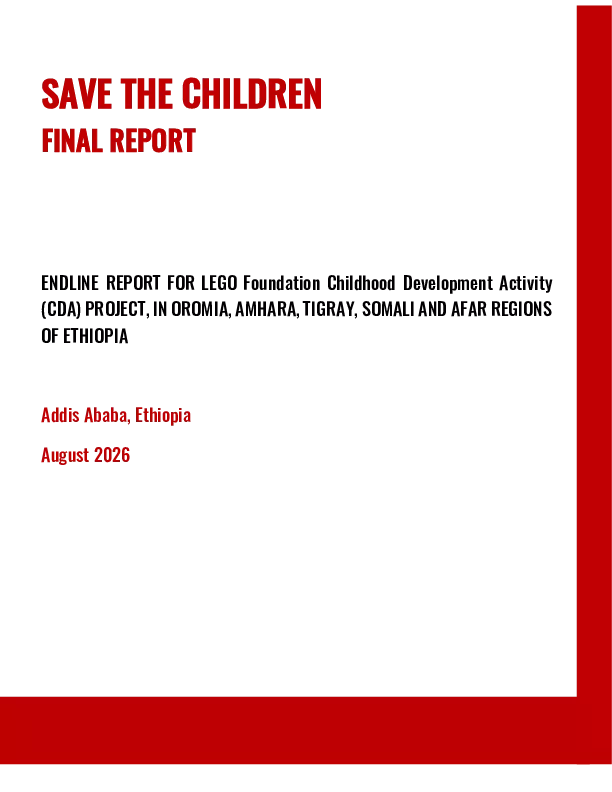
Endline Evaluation Final Report: LEGO Foundation Childhood Development Activity in Ethiopia (2026)

Publication year:
2026

English

Format:
(1.5 MiB)

Publisher:
Save the Children Ethiopia
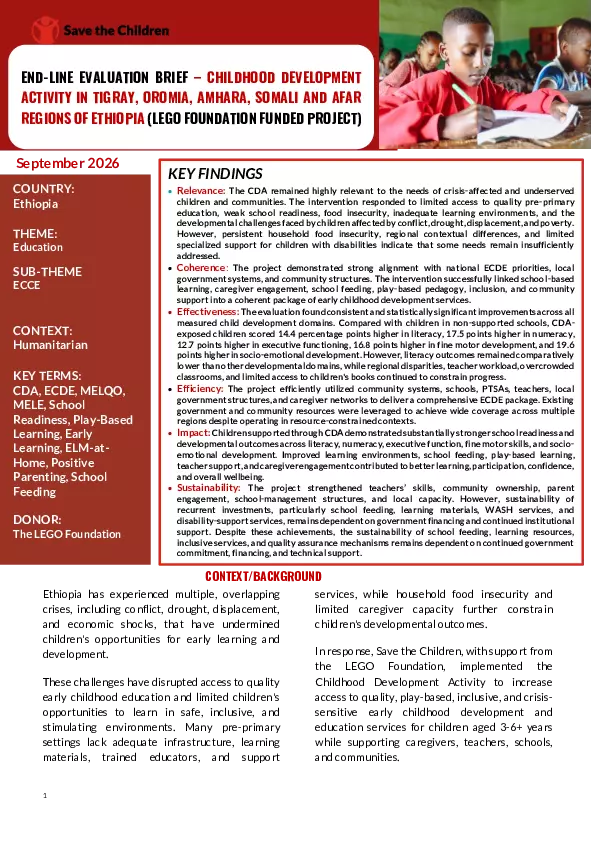
Young children living in crisis-affected settings face significant barriers to early learning and development. In Ethiopia, recurrent conflict, drought, displacement, and economic shocks have disrupted access to quality pre-primary education, weakened family resilience, and reduced opportunities for children to learn in safe, inclusive, and stimulating environments. To address these challenges, Save the Children International, with funding from the LEGO Foundation, implemented the Childhood Development Activity between 2022 and 2026 across Afar, Amhara, Oromia, Somali, and Tigray regions. The project aimed to improve children’s school readiness, learning, well-being, and holistic development through an integrated package of play-based early childhood education, school feeding, caregiver engagement, teacher capacity strengthening, inclusive education, mental health and psychosocial support, and community participation.
The endline evaluation assessed the project’s contribution to children’s learning and developmental outcomes using a mixed-methods quasi-experimental design. Quantitative data were collected from 931 children, 199 caregivers, and 69 teachers, complemented by classroom observations, key informant interviews, and focus group discussions. Child outcomes were measured using internationally recognized MELQO tools, while learning environments were assessed using the MELE framework.
The evaluation found strong evidence that children participating in CDA-supported early childhood development services achieved significantly better outcomes than children in comparison schools across all measured developmental domains. After adjusting for background characteristics, CDA-exposed children scored 14.4 percentage points higher in literacy, 17.5 points higher in numeracy, 12.7 points higher in executive functioning, 16.8 points higher in fine motor development, and 19.6 points higher in socio-emotional development. These gains were observed across boys and girls, rural and urban children, and children both affected and unaffected by shocks, indicating broad and equitable benefits of the intervention.
The evaluation identified several factors that contributed to these outcomes. CDA-supported learning environments were significantly more likely to provide school feeding, play and learning materials, child-friendly classrooms, disability-accessible facilities, and improved learning conditions. Teachers demonstrated stronger access to professional development, coaching, learning resources, and play-based teaching approaches, while caregivers reported increased engagement in children’s learning through home-based literacy and numeracy activities. The integrated package of school-based and home-based support helped create a continuum of learning that extended beyond the classroom into families and communities.
The findings demonstrate that integrated, play-based early childhood development programming can substantially improve learning, school readiness, and holistic development outcomes in fragile and humanitarian contexts. Beyond learning gains, the project strengthened community ownership, caregiver engagement, inclusive education practices, and support systems for vulnerable children. However, sustaining these gains will require continued investment in school feeding, learning materials, WASH facilities, disability inclusion services, teacher support, and government-led transition mechanisms. The evaluation provides compelling evidence that the CDA model offers an effective and scalable approach for improving early childhood development outcomes among vulnerable and crisis-affected children in Ethiopia.
Read full abstract


View & Download


Document information
Publisher
Authors
Content type
Country
Region
Topics
Rights
© Author/Publisher
Found a mistake? Help us improve!
If you have noticed a document assigned to the wrong author or any other inaccuracies, let us know! Your feedback helps us keep our data accurate and useful for everyone.
 Subscribe and receive reading selections
 Save all your favorite materials for future use
 Upload research & contribute to the collection

Share

Link