
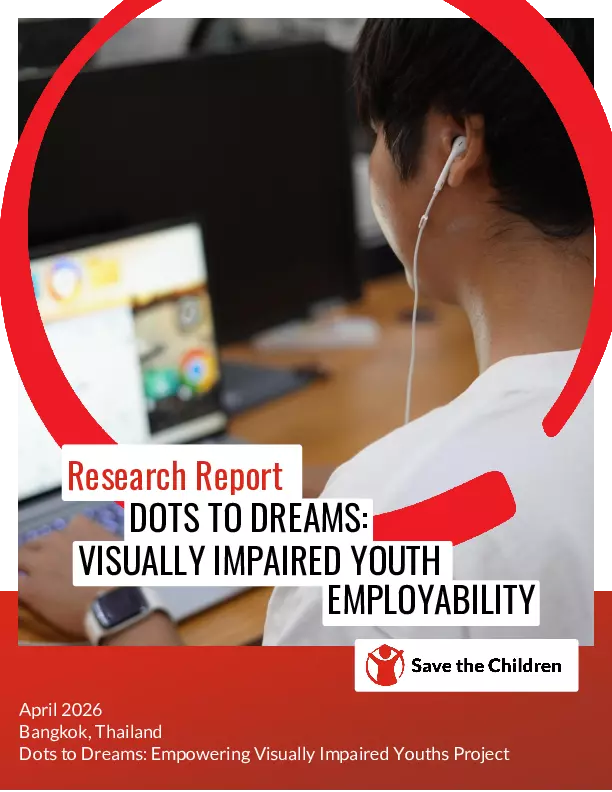
Study: Research
Dots to Dreams: Visually Impaired Youth Employability (Thailand, 2026)

Publication year:
2026

English

Format:
(1.9 MiB)

Publisher:
Save the Children Thailand
This report presents findings from the Dots to Dreams: Visually Impaired Youth Employability study conducted in Bangkok, Thailand, aimed at understanding employment pathways, barriers, and opportunities for visually impaired youth aged 18–30. The study seeks to inform the design of inclusive employment programmes, particularly the adaptation of Save the Children’s Life Skills for Success (LS4S) framework.
Using a qualitative approach, data were collected from 81 participants—including visually impaired youth, employers, civil society organisations, educators, and government stakeholders—through focus group discussions, key informant interviews, and desk review. The analysis applies a rights-based and Gender Equality, Disability and Social Inclusion (GEDSI) lens.
Findings show that visually impaired youth possess strong transferable life skills such as communication, adaptability, and problem-solving, often developed through lived experience. However, a significant gap exists between these capabilities and available employment opportunities. Jobs are limited, frequently low-skilled, and often shaped by compliance with disability quota systems rather than meaningful inclusion. Key challenges include weak transition mechanisms from education to employment, inadequate career guidance, and limited alignment between training systems and labour market demands.
At the system level, the employability ecosystem is fragmented, with poor coordination among key institutions and heavy reliance on intermediaries such as civil society organisations for job matching and workplace integration. Employer perceptions, accessibility barriers, and policy implementation gaps further constrain access to secure and quality employment. Although Thailand has strong legal frameworks supporting disability rights, implementation prioritises compliance over long-term inclusion, job quality, and career progression.
The study concludes that while visually impaired youth demonstrate strong potential, employment outcomes are primarily limited by structural and systemic barriers rather than individual capability. Strengthening coordination across the ecosystem, improving employer engagement, and aligning skills development with labour market needs are critical to achieving sustainable and inclusive employment pathways.
Read full abstract


View & Download

English
1 Documents


Document information
Publisher
Authors
Content type
Country
Region
Topics
Rights
© Author/Publisher
Found a mistake? Help us improve!
If you have noticed a document assigned to the wrong author or any other inaccuracies, let us know! Your feedback helps us keep our data accurate and useful for everyone.
 Subscribe and receive reading selections
 Save all your favorite materials for future use
 Upload research & contribute to the collection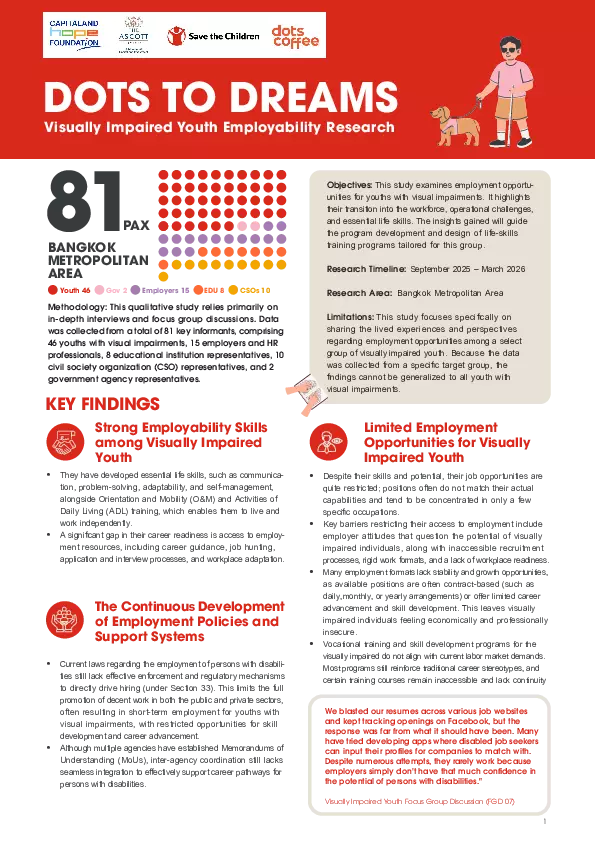

Share

Link