
Reports
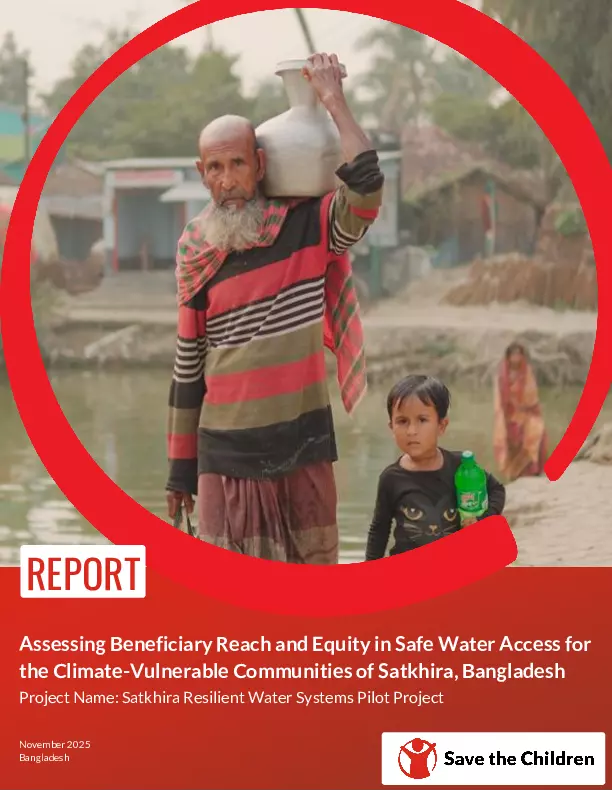
Assessing Beneficiary Reach and Equity in Safe Water Access for the Climate-Vulnerable Communities of Satkhira, Bangladesh (2025)

Publication year:
2025

English

Format:
(675.5 KiB)

Publisher:
Save the Children Bangladesh
Access to safe drinking water remains a critical challenge in the climate-vulnerable coastal district of Satkhira, Bangladesh, where salinity intrusion, cyclones, and flooding frequently compromise traditional water sources. To address this issue, Save the Children, in collaboration with Uttaran and technical partners, established community-based Reverse Osmosis (RO) water points and Pond Sand Filters (PSFs). This assessment aimed to estimate the number of beneficiaries, analyse water consumption patterns, and examine equity in water access to support sustainable water management. A quantitative approach was applied through a structured registration and monitoring system over 52 days. During the initial 7-day registration period, 7,911 households (32,100 members) were registered, followed by 45 days of monitoring of water collection at five RO sites. Findings show that 7,380 unique users collected water 41,229 times, consuming over 1.1 million litres during the monitoring period. While most households accessed water without transportation costs, disparities remain in access time, usage patterns, and socio-economic participation. The study highlights the importance of equitable and climate-resilient community water systems and provides evidence to support sustainable pricing and water governance models.
Read full abstract
Authors


View & Download


Document information
Publisher
Authors
Content type
Country
Region
Rights
© Author/Publisher
Found a mistake? Help us improve!
If you have noticed a document assigned to the wrong author or any other inaccuracies, let us know! Your feedback helps us keep our data accurate and useful for everyone.
 Subscribe and receive reading selections
 Save all your favorite materials for future use
 Upload research & contribute to the collection
Share

Link