
Study: Research
Addressing Adolescent Pregnancy and Maternal and Neonatal Health Services: A Policy and Support System Analysis of Hard-to-Reach Areas in Rangpur, Bangladesh (2024)

Publication year:
2024

English

Format:
(678.2 KiB)

Publisher:
American Academic Scientific Research Journal for Engineering, Technology, and Sciences
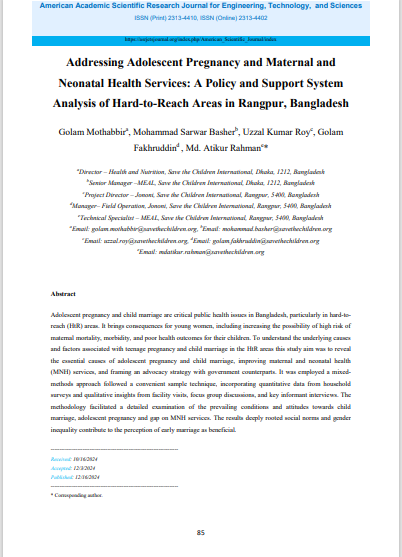
Adolescent pregnancy and child marriage are critical public health issues in Bangladesh, particularly in hard-to-reach (HtR) areas. It brings consequences for young women, including increasing the possibility of high risk of maternal mortality, morbidity, and poor health outcomes for their children. To understand the underlying causes and factors associated with teenage pregnancy and child marriage in the HtR areas this study aim was to reveal the essential causes of adolescent pregnancy and child marriage, improving maternal and neonatal health (MNH) services, and framing an advocacy strategy with government counterparts. It was employed a mixed-methods approach followed a convenient sample technique, incorporating quantitative data from household surveys and qualitative insights from facility visits, focus group discussions, and key informant interviews.
The methodology facilitated a detailed examination of the prevailing conditions and attitudes towards child marriage, adolescent pregnancy and gap on MNH services. The results deeply rooted social norms and gender inequality contribute to the perception of early marriage as beneficial. This is further exacerbated by limited economic opportunities and educational access in these districts. Six out of ten adolescent girls of surveyed household are married, with a significant number of them are going or gone through pregnancy. These phenomena are largely driven by socio-economic factors, including poverty and restricted access to education, which compel families to view marriage to secure a girl’s financial future.
For both child marriage and adolescent pregnancy, a peer pressure from family and society has been observed. Its highlights the entirely lack of awareness about the health risks associated with* child marriage and adolescent pregnancy. Mothers often skip the antenatal care (ANC) and postnatal care (PNC) visits due to ignorance or financial constraint. Additionally, gaps in the availability and quality of MNH services were evident, particularly at the union and upazila levels. Most of the deliveries take place at home (50.3%) under the supervision of birth attendants (both skilled and traditional) of which 26.8% are traditional birth attendants.
Overall, the study highlighted social, economic, and cultural elements that contribute to improve levels of child marriage and adolescent pregnancy in Rangpur and Lalmonirhat, specifically in HtR areas. The lack of sufficient access to high-quality MNH services, especially those tailored to meet the needs of adolescents, worsens the health risks faced by young mothers and their newborns. Inadequate enforcement of the legally mandated minimum age for marriage, coupled with a lack of understanding of the health hazards, were identified as substantial elements that contribute to the issue.
Read full abstract
Authors


View & Download


Document information
Authors
Content type
Country
Region
Rights
© Author/Publisher
Found a mistake? Help us improve!
If you have noticed a document assigned to the wrong author or any other inaccuracies, let us know! Your feedback helps us keep our data accurate and useful for everyone.
 Subscribe and receive reading selections
 Save all your favorite materials for future use
 Upload research & contribute to the collection
Share

Link