Study: Evaluations
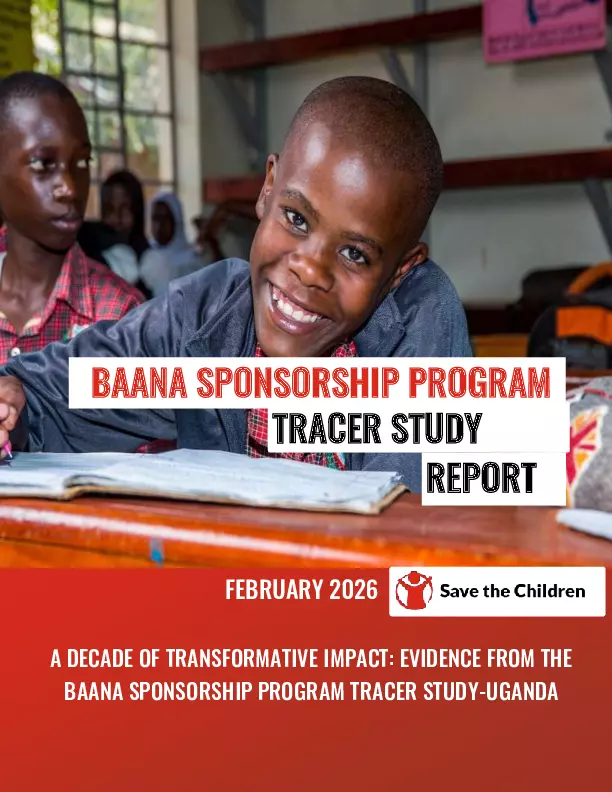
A Decade of Transformative Impact: Evidence from the Baana Sponsorship Program Tracer Study (Uganda, 2026)

Publication year:
2026

English

Format:
(1.5 MiB)

Publisher:
Save the Children Uganda
This tracer study examines the sustainability of outcomes achieved through the Baana Sponsorship Program, a multi-sectoral child development initiative implemented by Save the Children International Uganda in Wakiso District between 2014 and 2026. The study assessed the extent to which gains in education, leadership and advocacy, household economic resilience, health and hygiene practices, and child protection have been sustained among former programme beneficiaries and their households.
Using a concurrent mixed-methods design, the study collected quantitative data from 895 former beneficiaries and 839 households, complemented by focus group discussions, key informant interviews, and longitudinal case narratives.
Findings indicate strong sustainability of educational outcomes, with 97.8% of former ECCD graduates and 95.6% of former primary school graduates remaining enrolled in education. Household economic gains were also sustained, with more than half of households maintaining participation in Village Savings and Loan Associations and practicing regular budgeting and education-related savings. The study further found sustained retention of key health and hygiene behaviours, continued utilization of child protection reporting mechanisms, and evidence of emerging leadership and advocacy competencies among former beneficiaries. The findings demonstrate that integrated investments in education, health, child protection, community systems strengthening, and household resilience can generate durable and mutually reinforcing outcomes that extend beyond direct programme support.
However, sustaining gains in secondary education, disability inclusion, adolescent transitions, and economic opportunities for youth remains critical for consolidating long-term impact. The study provides evidence to inform future child development programming, sustainability planning, and policy dialogue on integrated approaches to improving children’s well-being.
Read full abstract


View & Download


Document information
Publisher
Authors
Content type
Country
Region
Topics
Adolescent, Sexual and Reproductive Health and Rights, Advocacy, Appropriate Care, Basic Education, Child Health, Child Participation, Child Poverty, Child Protection, Child Protection Systems, Child Rights and Business, Child Rights Governance, Child Rights Programming, Child Safeguarding, Early Childhood Care and Development, Food Security and Livelihoods, Health and Nutrition, Monitoring and Demanding Child Rights with Children, Protection of Children from Violence, Public Investment in Children, Urban Contexts, Water, Sanitation and Hygiene (WASH)
Rights
© Author/Publisher
Found a mistake? Help us improve!
If you have noticed a document assigned to the wrong author or any other inaccuracies, let us know! Your feedback helps us keep our data accurate and useful for everyone.
 Subscribe and receive reading selections
 Save all your favorite materials for future use
 Upload research & contribute to the collection
Share

Link