
Study: Assessments
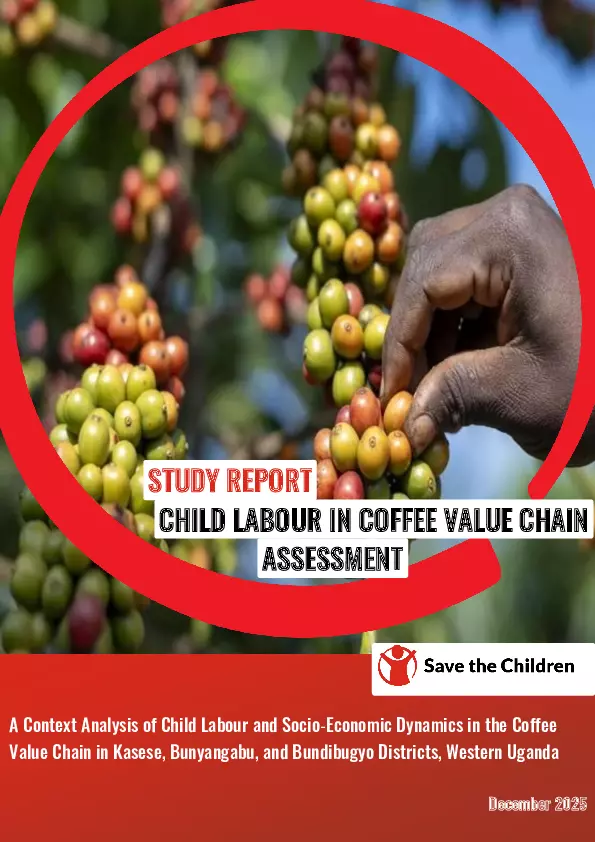
A Context Analysis of Child Labour and Socio-Economic Dynamics in the Coffee Value Chain in Kasese, Bunyangabu, and Bundibugyo Districts, Western Uganda (2026)

Publication year:
2026

English

Format:
(1.6 MiB)

Publisher:
Save the Children Uganda
This study presents a comprehensive assessment of child labour and socio-economic dynamics within the coffee value chain in Kasese, Bunyangabu, and Bundibugyo districts of Western Uganda. Commissioned by Save the Children Uganda with funding from Save the Children Italy, the study was conducted to generate evidence on the prevalence, drivers, and consequences of child labour, while examining livelihood vulnerabilities, value chain dynamics, youth participation, and opportunities for sustainable household resilience.
A mixed-methods approach was employed, including a survey of 558 coffee-farming households and 1,201 children, complemented by key informant interviews, focus group discussions, participatory workshops, life-history interviews, case studies, and direct observations.
Findings indicate that coffee remains a critical livelihood source for smallholder households but is characterised by low productivity, climate-related risks, limited market access, and heavy reliance on family labour. Child labour was found to be widespread, affecting 39% of children aged 5–17 years, while 24% were engaged in hazardous work. Poverty, household vulnerability, labour-intensive production systems, entrenched social norms, and limited educational opportunities emerged as key drivers. The study further highlights weaknesses in labour inspection, enforcement, and child labour monitoring systems despite Uganda’s relatively robust policy and legal framework.
Findings underscore the need for integrated interventions that address household economic vulnerability, strengthen child protection and labour monitoring mechanisms, improve access to quality education, promote climate-smart and productive coffee systems, and expand youth engagement in higher-value and sustainable livelihood opportunities. The report provides evidence to inform future programming, policy dialogue, corporate due diligence efforts, and multi-stakeholder action aimed at eliminating child labour and promoting sustainable development within Uganda’s coffee sector.
Read full abstract


View & Download


Document information
Publisher
Authors
Content type
Country
Region
Topics
Rights
© Author/Publisher
Found a mistake? Help us improve!
If you have noticed a document assigned to the wrong author or any other inaccuracies, let us know! Your feedback helps us keep our data accurate and useful for everyone.
 Subscribe and receive reading selections
 Save all your favorite materials for future use
 Upload research & contribute to the collection
Share

Link