
Policies, Standards, and Strategies
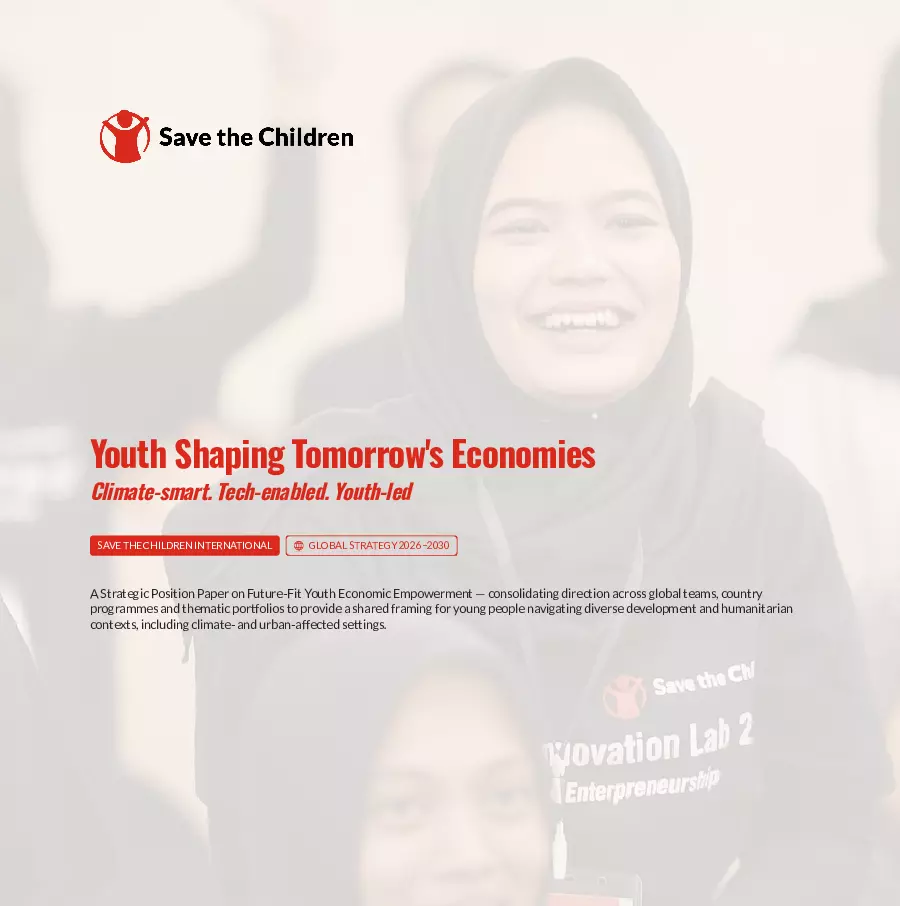
Youth Shaping Tomorrow’s Economies: Repositioning Youth Economic Empowerment for Future-Fit Economies (2026)

Publication year:
2026

English

Format:
(7.5 MiB)

Publisher:
Save the Children International
‘Youth Shaping Tomorrow’s Economies’ is a strategic position paper by Save the Children, repositioning our Youth Livelihoods and Economic Empowerment portfolio to match the ambitions of a changing market. It serves as a lean, high-impact technical and strategic global framework designed to anchor youth livelihoods within macro-economic realities. It synthesises existing evidence and global megatrends regarding the future of work, laying out a forward-looking strategic vision where young people thrive, contribute to resilient economies, and shape a better future for all.
Save the Children is executing a deliberate structural shift from traditional youth livelihoods programming toward a systems-level approach to youth economic empowerment. Today’s landscape is shaped by deep economic volatility, climate disruption, rapid digital transformation, displacement, and demographic pressures. In this increasingly unpredictable environment, isolated, short-cycle skills training or standalone income-generating activities have reached their structural limits. In fact, these traditional models inadvertently transfer long-term economic transition risks onto the most vulnerable young people. This position paper establishes a shared, rigorous framing to ensure our programming targets the broader markets, policies, and institutions that dictate whether economic transitions are dignified, safe, and sustainable across development, humanitarian, and climate-affected contexts.
What makes this strategy distinctly different is its emphasis on systemic change, domain-driven investment, and focus on equity and inclusion. First, it moves beyond siloed, project-based activities toward sustained engagement with the market systems, policies, and institutions that shape youth economic outcomes at scale. Second, it concentrates resources and strategic partnerships into three interconnected, future-facing domains where long-term opportunity and resilience intersect: Green and Climate-Resilient Economies; STEM, Digital, and Tech-Enabled Economies; and Enterprise and Market Economies. Finally, it places equity at the centre, addressing the compounded structural barriers facing young women, youth in humanitarian settings, youth with disabilities, and displaced or stateless young people. Ultimately, this framework provides a unifying strategic lens that empowers young people not just to navigate existing economies, but to actively co-architect and shape tomorrow’s.
Read full abstract
Authors


View & Download


Document information
Publisher
Authors
Content type
Country
Rights
© Author/Publisher
Found a mistake? Help us improve!
If you have noticed a document assigned to the wrong author or any other inaccuracies, let us know! Your feedback helps us keep our data accurate and useful for everyone.
 Subscribe and receive reading selections
 Save all your favorite materials for future use
 Upload research & contribute to the collection
Share

Link