Study: Evaluations
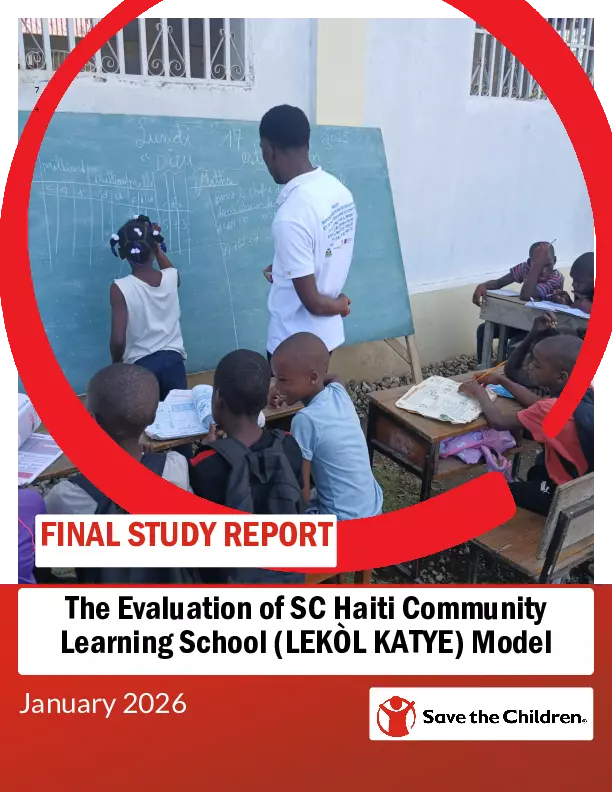
The Evaluation of SC Haiti Community Learning School (Lekòl Katye) Model

Publication year:
2026

English

Format:
(2.3 MiB)

Publisher:
Save the Children Haiti
This report presents the evaluation of the Lekòl Katye (Community Learning School) model, an education in emergencies intervention implemented in Haiti since 2022. Operating in Port-au-Prince and the Greater South, the model provides proximate, safe learning spaces combining accelerated and remedial education, continuity of formal schooling during violence-induced closures, psychosocial support, and food assistance. The evaluation was conducted by Laterite using a mixed-methods design integrating primary qualitative data — 18 key informant interviews — with a secondary quantitative component based on program monitoring records — ASER assessments and a post-distribution monitoring survey. Progress was assessed against the OECD-DAC criteria of relevance, coherence, effectiveness, efficiency, impact, and learning and adaptation.
Findings indicate that the model was highly relevant to crisis-affected communities and coherent with the Haitian formal school system and collective humanitarian response, successfully fulfilling a dual function: providing after-school remediation when schools are open and serving as a substitute learning space during closures, sustained by the engagement and flexibility of teachers and facilitators. Quantitative results suggest improvements in numeracy, with comparatively more limited gains in literacy, though these trends cannot be causally attributed to the intervention. Stakeholders consistently reported high retention and perceived protective benefits, including reduced exposure to violence and improved psychosocial wellbeing. The model demonstrated operational efficiency in an extremely volatile environment; however, infrastructure gaps, delayed teacher payments (which risk undermining staff motivation), geographic and gender inequities, and inconsistency in psychological support delivery remain areas requiring attention.
The evaluation concludes that the model requires consolidation through a formalized minimum service package, validated certification pathways with education authorities, gender-responsive and disability-inclusive pedagogical strategies, enhanced psychological support and nutritional strategies, more systematic financial execution, and a strengthened M&E system with individual-level tracking to support scale-up and long-term sustainability.
Read full abstract
View & Download

English
1 Documents


Document information
Publisher
Content type
Country
Region
Rights
© Author/Publisher
Found a mistake? Help us improve!
If you have noticed a document assigned to the wrong author or any other inaccuracies, let us know! Your feedback helps us keep our data accurate and useful for everyone.
 Subscribe and receive reading selections
 Save all your favorite materials for future use
 Upload research & contribute to the collection
Share

Link