Study: Evaluations
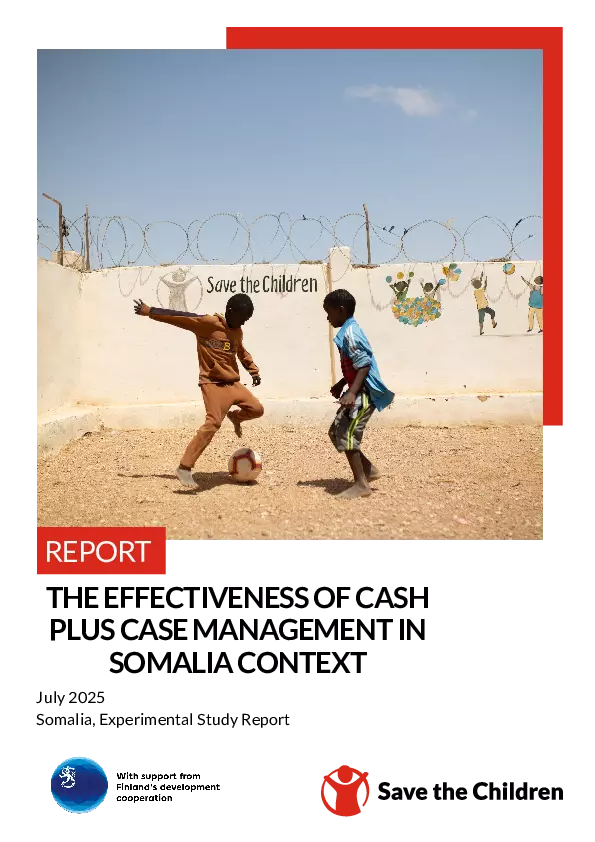
The Effectiveness of Cash Plus Case Management in Somalia Context (2025)

Publication year:
2025


Format:
(4.0 MiB)

Publisher:
Save the Children Somalia/Somaliland
This study evaluates the impact and effectiveness of an integrated child protection and social protection intervention, combining child protection case management (CM) with multipurpose cash assistance (MPCA), on child protection outcomes in Abudwak district, Somalia. Funded by the Finnish Ministry for Foreign Affairs, supported by Save the Children Finland (SCF), and implemented by Save the Children Somalia in partnership with Somali Peace Line, the project aimed to address both the economic and social drivers of child protection risks among vulnerable children and families. A total of 220 households with children at medium to high protection risk, eligible for both CM and MPCA, were enrolled and randomly assigned to receive either case management alone or the integrated CM, MPCA package. The study employed a mixed-methods design, including a randomized controlled experiment, and in-depth qualitative interviews with children, caregivers, caseworkers, and community actors.
The study findings demonstrate significant improvements over time across a range of child protection, wellbeing, and food security outcomes. These included higher school enrolment, reduced child labour (measured in hours worked) and violent discipline, improved caregiver and child psychological wellbeing, and greater household food security. Many of these improvements were associated with shared exposure to case management, while the addition of MPCA contributed to gains in specific domains. The results suggest that case management was a powerful standalone intervention, while the addition of MPCA enhanced certain outcomes, particularly in domains sensitive to financial stress.
The integrated approach led to measurable improvements in household food security, school enrolment, ability of caregivers to set effective discipline rules, and caregiver-child interaction. In contrast, the integrated approach had a smaller impact on child psychological wellbeing compared to case management alone. For most other outcomes, including child labour, violent discipline, and caregiver psychological wellbeing, the analysis did not detect a statistically significant added benefit from MPCA. These improvements were instead likely driven by shared exposure to case management and related psychosocial interventions
The study highlights the central role of case management, community parenting sessions, school engagement, and psychosocial support as key drivers of change. Caregiver wellbeing also emerged as a strong predictor of child wellbeing, underscoring the importance of holistic, household-level support. These results offer actionable insights for strengthening integrated child protection and cash programming and are intended to inform the scale-up of similar approaches in Somalia and other humanitarian settings.
Read full abstract
Authors


View & Download

English
1 Documents


Document information
Publisher
Content type
Country
Region
Rights
© Author/Publisher
Found a mistake? Help us improve!
If you have noticed a document assigned to the wrong author or any other inaccuracies, let us know! Your feedback helps us keep our data accurate and useful for everyone.
 Subscribe and receive reading selections
 Save all your favorite materials for future use
 Upload research & contribute to the collection
Share

Link