Reports
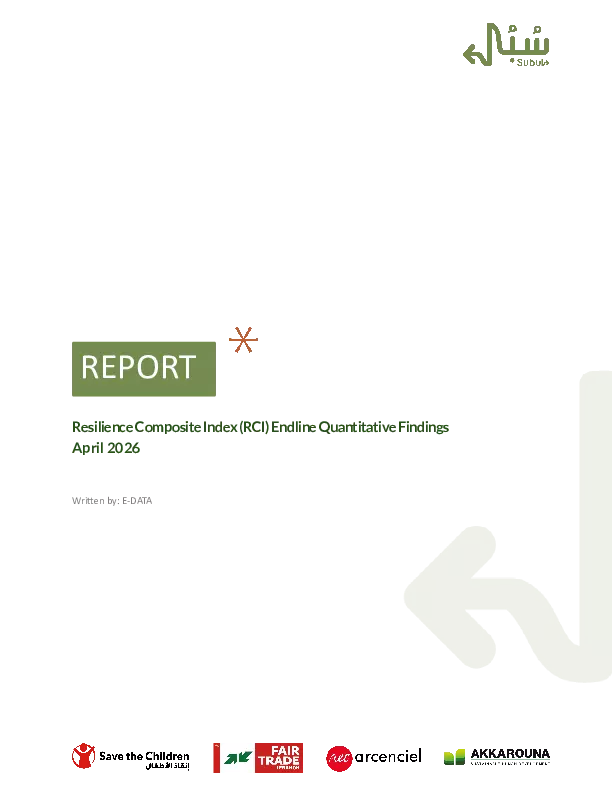
SUBUL: Resilience Composite Index (RCI) Endline Quantitative Findings (Lebanon, 2026)

Publication year:
2026

English

Format:
(2.9 MiB)

Publisher:
Save the Children Lebanon
The endline Resilience Capacity Index (RCI) assessment of 361 matched households participating in the SUBUL consortium project across Akkar, Bekaa, Mount Lebanon, and Beirut found measurable improvements in resilience, food security, and the ability to meet basic needs. Overall, 75.4% of households improved their RCI scores, severe hunger declined from 52.8% to 37.4%, and more households moved into moderate or higher resilience categories. Despite these gains, vulnerability remained widespread. Food was the primary unmet need (93.6%), 82.0% of households still experienced some level of hunger, 73.1% relied on crisis or emergency coping strategies, and most households faced negative income balances, high debt, and limited savings. Food insecurity and low resilience were particularly acute in Bekaa and Akkar. The findings suggest that the SUBUL livelihoods approach contributed to positive but fragile resilience outcomes, highlighting the continued need for integrated livelihoods, cash assistance, debt management, and shock-preparedness support, especially in the most vulnerable regions.
Read full abstract
Authors


View & Download


Document information
Publisher
Authors
Content type
Country
Region
Rights
© Author/Publisher
Found a mistake? Help us improve!
If you have noticed a document assigned to the wrong author or any other inaccuracies, let us know! Your feedback helps us keep our data accurate and useful for everyone.
 Subscribe and receive reading selections
 Save all your favorite materials for future use
 Upload research & contribute to the collection
Share

Link