
Study: Evaluations
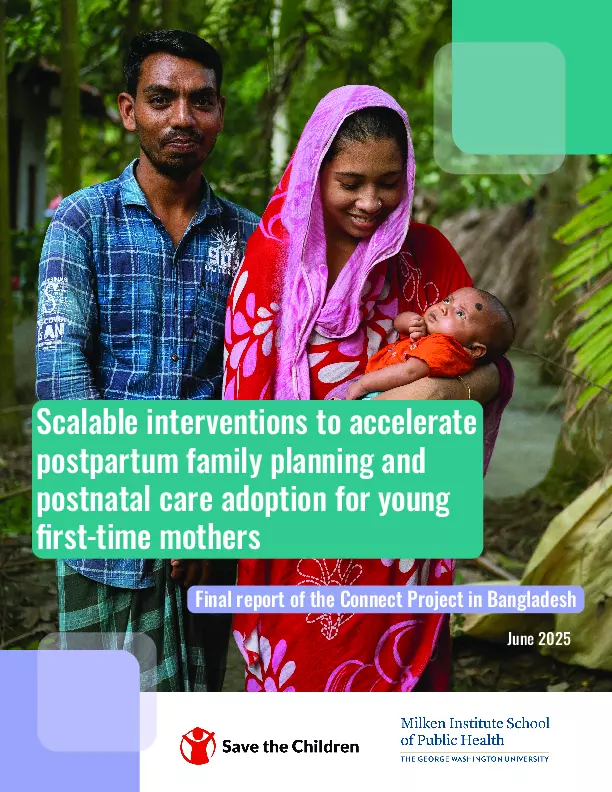
Scalable Interventions to Accelerate Postpartum Family Planning and Postnatal Care Adoption for Young First-Time Mothers: Final Report of the Connect Project in Bangladesh (June 2025)

Publication year:
2025

English

Format:
(6.8 MiB)

Publisher:
George Washington University,Save the Children
The Connect Project, implemented from 2019 to 2025 in Bangladesh, aimed to accelerate the adoption of postpartum family planning (PPFP) and postnatal care (PNC) among young first-time mothers (FTMs). Led by Save the Children and George Washington University in collaboration with the Ministry of Health and Family Welfare, the project introduced scalable, light-touch interventions—termed “enhancements”—that were integrated into existing government health systems at both community and facility levels.
Community-level enhancements included home visits by Family Welfare Assistants (FWAs) using a risk-screening algorithm, monthly courtyard meetings, distribution of mother-baby booklets and invitation cards, and provision of short-acting contraceptives. Facility-level enhancements focused on a pre-discharge counseling checklist and a PNC quality improvement bundle. These interventions were piloted and scaled across six upazilas in Noakhali and Madaripur districts, reaching over 54,000 FTMs and training 1,345 health providers.
A cluster-randomized controlled trial (cRCT) evaluated the impact of these enhancements. While no statistically significant effects were found on primary outcomes—PPFP adoption and PNC uptake—the project demonstrated a 27% reduction in moderate depression among FTMs and suggestive improvements in family planning self-efficacy. Implementation challenges included low coverage due to staff shortages, high workloads, and under-resourced facilities.
Qualitative findings highlighted the influence of social norms, family dynamics, and misinformation on service uptake. The pre-discharge checklist showed high acceptability and feasibility, with potential for institutionalization. However, sustainability of community-level enhancements, particularly the risk algorithm, faced barriers due to limited supervisory support, documentation challenges, and systemic constraints.
The report concludes with recommendations to prioritize young mothers in health services, strengthen the FWA cadre, engage families and local leaders, and design interventions that align with existing health system capacities for sustainable scale-up.
Read full abstract
View & Download


Document information
Content type
Country
Region
Topics
Rights
© Author/Publisher
Found a mistake? Help us improve!
If you have noticed a document assigned to the wrong author or any other inaccuracies, let us know! Your feedback helps us keep our data accurate and useful for everyone.
 Subscribe and receive reading selections
 Save all your favorite materials for future use
 Upload research & contribute to the collection

Share

Link