
Publication year:
2026

English, Bengali/Bangla,French,Ukrainian

Format:
(6.1 MiB)

Publisher:
Save the Children
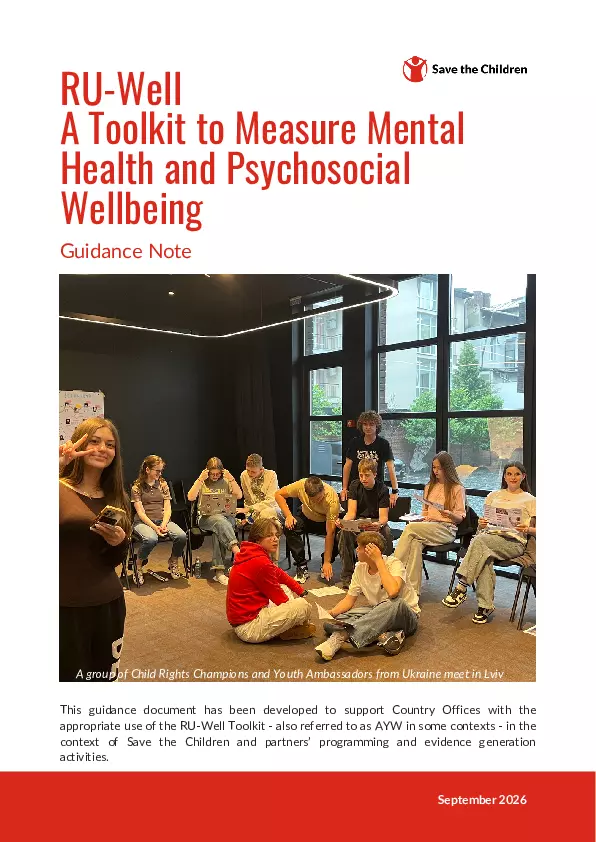
The RU-WELL Toolkit is designed to serve as pre- and post-intervention monitoring and evaluation measure, tracking children and adolescent mental health and psychosocial wellbeing over time. Specifically, the tool focuses on measuring and monitoring two MHPSS dimensions: social connectedness and the ability to cope. To ensure maximum utility, the RU-WELL toolkit should be integrated into programmes and interventions that are intentionally designed to have a direct impact on one or both of these dimensions.
The RU-WELL Toolkit contains quantitative and qualitative assessment components to enable mixed methods triangulation of children and adolescent wellbeing:
The toolkit was developed through a rigorous and iterative process. It was initially field-tested and refined in complex humanitarian contexts, including Niger and the Democratic Republic of Congo (DRC). To validate its psychometric properties and statistical validity, extensive psychometric assessments were conducted in Cox’s Bazar, Bangladesh, with adolescents living in refugee camps and those residing in surrounding local host communities. This testing confirmed that the quantitative tool has strong reliability and validity when adapted properly. Further validation pilots were conducted in Ukraine, Mali and Niger which galvanized the toolkit’s reliability and validity. Although the RU-WELL Toolkit was designed for these settings, it is intended for global use, provided it is appropriately adapted before implementation. Adapting assessment materials for use in the local context ensures they are accurately translated and locally understandable, acceptable and relevant.
For more information on the RU-WELL Toolkit, please contact Marta Petagna and Tata De Jesus.
Read full abstract


Autodetected language
English
8 Documents
Other languages
Bengali/Bangla
2 Documents
Ukrainian
2 Documents
Publisher
Authors
Content type
Rights
© Author/Publisher
If you have noticed a document assigned to the wrong author or any other inaccuracies, let us know! Your feedback helps us keep our data accurate and useful for everyone.
 Subscribe and receive reading selections
 Save all your favorite materials for future use

Share

Link



 Upload research & contribute to the collection