
Publication year:
2026

English

Format:
(1.5 MiB)

Publisher:
BRIGHTLY consortium,CARE International,NRC, Norwegian Refugee Council,Oxfam,Save the Children,Yemen Family Care Association (YFCA)
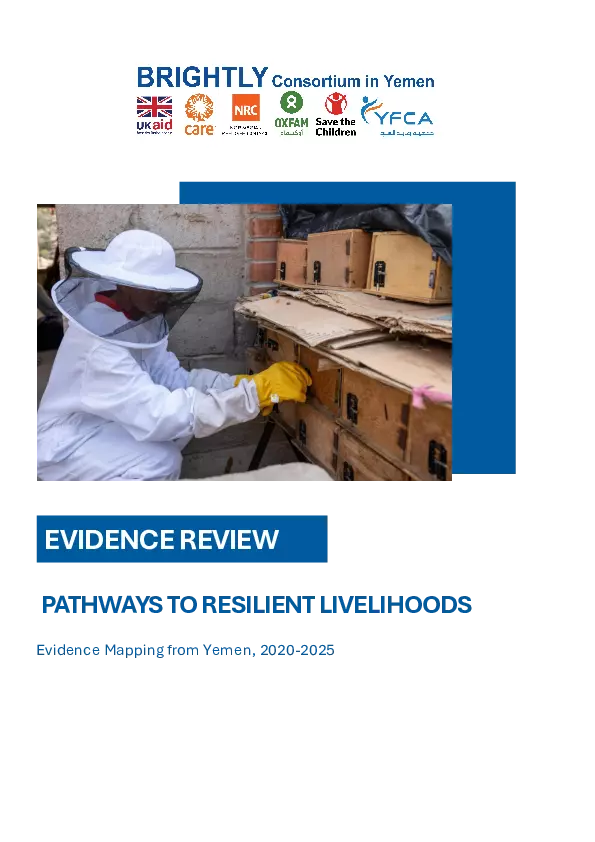
The Building Resilience through Integrated Community-based and Humanitarian Systems Transformation and Leadership (BRIGHTLY) programme is a four-year FCDO-funded consortium initiative in Yemen that integrates humanitarian assistance, livelihoods support, and social protection strengthening to enable households to progress toward economic self-reliance. This study reviews publicly available evidence on livelihoods and transition programming in Yemen from 2020 to 2025 to synthesise lessons relevant to BRIGHTLY’s approach and identify priority evidence gaps for its final phase. The report defines transition as movement from short-term humanitarian assistance toward sustainable livelihoods or longer-term social protection; this review focuses specifically on transitions to livelihoods.
The evidence base is strongest in demonstrating short-term stabilisation effects, particularly improvements in food security and reduced reliance on negative coping strategies through cash assistance. There is also consistent evidence on the value of multi-component approaches that combine immediate support with livelihoods interventions. Emerging findings indicate that transfer frequency influences outcomes, with more regular cash transfers associated with improved food security even when total transfer values remain constant. Robust evidence is primarily derived from household-level indicators such as food consumption, income, and coping behaviours, while reliance on indirect or perception-based measures yields weaker conclusions.
However, evidence remains insufficient to define what constitutes a successful transition or to establish thresholds indicating movement beyond short-term stabilisation. Transition is better understood as a gradual, context-dependent process in which some households reduce dependency on emergency support through strengthened livelihoods, while others continue to require intermittent assistance.
Significant gaps persist regarding the durability of livelihood gains after assistance ends, optimal sequencing or layering of interventions, and the most effective duration and targeting of support for different household groups. Limited evidence also exists on innovative livelihoods approaches, with programming largely reliant on established models. Weak market systems, recurrent shocks, climate pressures, high input costs, and fragile service systems continue to constrain outcomes.
Overall, the findings highlight a stronger evidence base on stabilisation than on sustainable livelihoods transitions and underscore the need for targeted learning to inform programme design, adaptation, and policy engagement.
Read full abstract

Publisher
Content type
Country
Region
Topics
Rights
© Author/Publisher
If you have noticed a document assigned to the wrong author or any other inaccuracies, let us know! Your feedback helps us keep our data accurate and useful for everyone.
 Subscribe and receive reading selections
 Save all your favorite materials for future use

Share

Link



 Upload research & contribute to the collection