
Reports
Malawi Household Economy Analysis (HEA) Livelihoods Baseline Profiles (May 2026)

Publication year:
2026

English

Format:
(11.7 MiB)

Publisher:
Save the Children
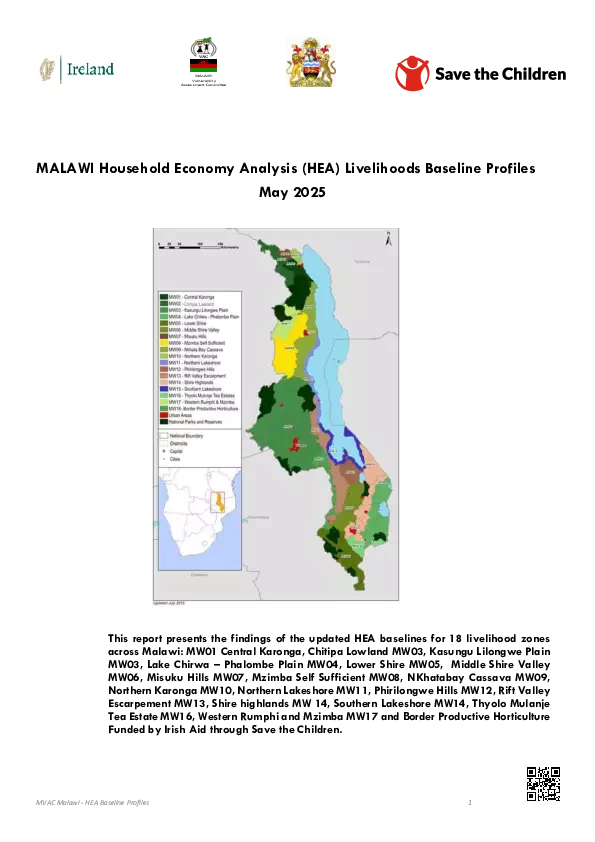
This report presents a comprehensive overview of livelihoods and food security across 18 livelihood zones in Malawi. It highlights how households access food and income, how wealth is distributed, and how shocks affect different population groups.
Agriculture is the backbone of livelihoods, with most households relying on crop production (especially maize) alongside livestock rearing and small-scale trade. Poorer households depend heavily on casual labour and informal activities, while wealthier households earn more from crop and livestock sales and diversified businesses.
Households are typically classified into four wealth groups—very poor, poor, middle, and better-off—based on land ownership, livestock, and productive assets. Food access varies significantly across these groups: poorer households rely more on market purchases, food aid, and labour payments, while better-off households depend mainly on their own production.
Food security outcomes differ by zone and year but are strongly influenced by climate shocks, high input costs, and pests. Common hazards include droughts, floods, and crop diseases, which have increased in frequency and severity, particularly affecting vulnerable households. To cope, poorer households increase labour activities, sell small livestock, or migrate, while wealthier households draw on assets, expand irrigation, and diversify income sources.
The resource emphasises key priorities for programming: improving access to agricultural inputs, expanding irrigation, strengthening markets and rural infrastructure, and enhancing social protection and financial services to build resilience among vulnerable households.
Read full abstract
View & Download


Document information
Publisher
Content type
Country
Region
Rights
© Author/Publisher
Found a mistake? Help us improve!
If you have noticed a document assigned to the wrong author or any other inaccuracies, let us know! Your feedback helps us keep our data accurate and useful for everyone.
 Subscribe and receive reading selections
 Save all your favorite materials for future use
 Upload research & contribute to the collection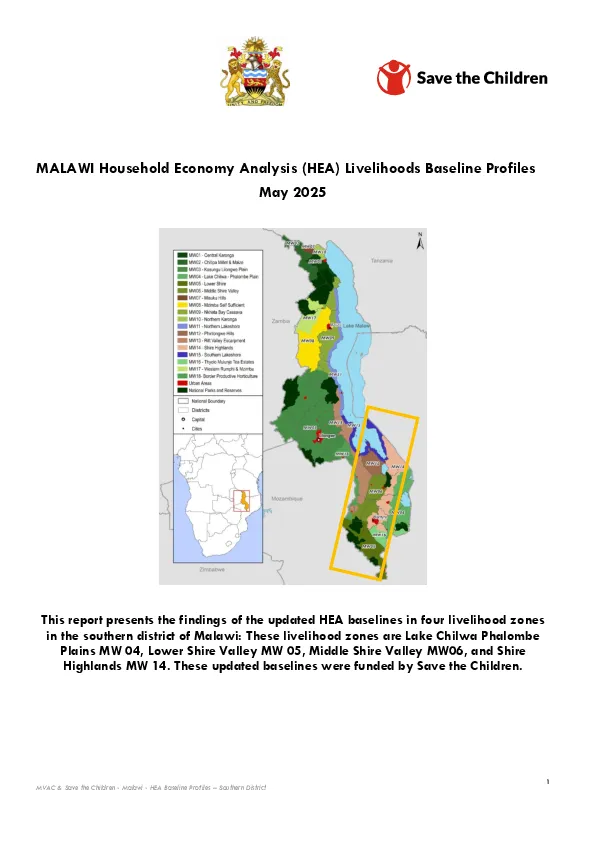

Share

Link