
Articles, Study: Evaluations
Levels and determinants of child wasting relapse: a prospective cohort study from Somalia

Publication year:
2026

English

Format:

Publisher:
Journal of Global Health
Background
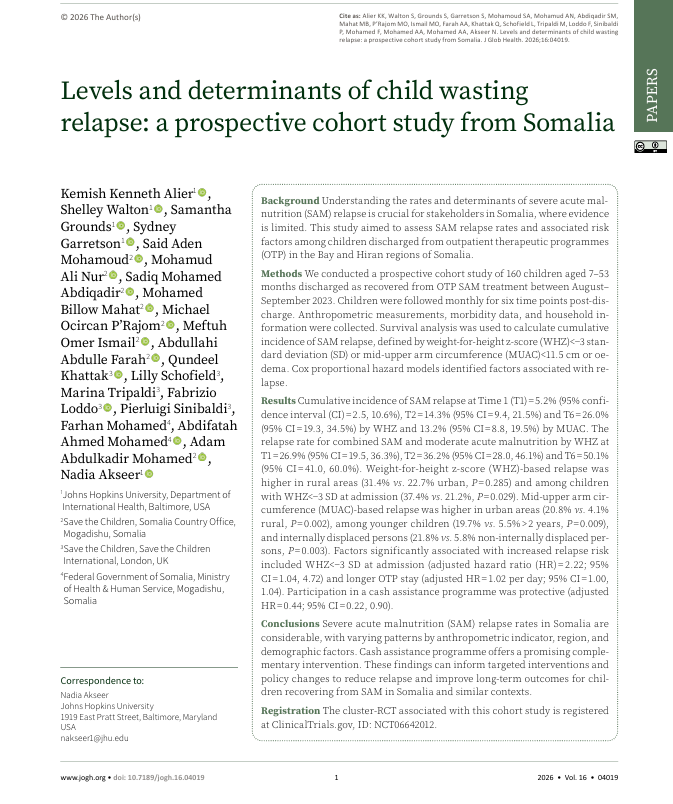
Understanding the rates and determinants of severe acute malnutrition (SAM) relapse is crucial for stakeholders in Somalia, where evidence is limited. This study aimed to assess SAM relapse rates and associated risk factors among children discharged from outpatient therapeutic programmes (OTP) in the Bay and Hiran regions of Somalia.
Methods
We conducted a prospective cohort study of 160 children aged 7–53 months discharged as recovered from OTP SAM treatment between August–September 2023. Children were followed monthly for six time points post-discharge. Anthropometric measurements, morbidity data, and household information were collected. Survival analysis was used to calculate cumulative incidence of SAM relapse, defined by weight-for-height z-score (WHZ)<−3 standard deviation (SD) or mid-upper arm circumference (MUAC)<11.5 cm or oedema. Cox proportional hazard models identified factors associated with relapse.
Results
Cumulative incidence of SAM relapse at Time 1 (T1) = 5.2% (95% confidence interval (CI) = 2.5, 10.6%), T2 = 14.3% (95% CI = 9.4, 21.5%) and T6 = 26.0% (95% CI = 19.3, 34.5%) by WHZ and 13.2% (95% CI = 8.8, 19.5%) by MUAC. The relapse rate for combined SAM and moderate acute malnutrition by WHZ at T1 = 26.9% (95% CI = 19.5, 36.3%), T2 = 36.2% (95% CI = 28.0, 46.1%) and T6 = 50.1% (95% CI = 41.0, 60.0%). Weight-for-height z-score (WHZ)-based relapse was higher in rural areas (31.4% vs. 22.7% urban, P = 0.285) and among children with WHZ<−3 SD at admission (37.4% vs. 21.2%, P = 0.029). Mid-upper arm circumference (MUAC)-based relapse was higher in urban areas (20.8% vs. 4.1% rural, P = 0.002), among younger children (19.7% vs. 5.5% > 2 years, P = 0.009), and internally displaced persons (21.8% vs. 5.8% non-internally displaced persons, P = 0.003). Factors significantly associated with increased relapse risk included WHZ<−3 SD at admission (adjusted hazard ratio (HR) = 2.22; 95% CI = 1.04, 4.72) and longer OTP stay (adjusted HR = 1.02 per day; 95% CI = 1.00, 1.04). Participation in a cash assistance programme was protective (adjusted HR = 0.44; 95% CI = 0.22, 0.90).
Conclusions
Severe acute malnutrition (SAM) relapse rates in Somalia are considerable, with varying patterns by anthropometric indicator, region, and demographic factors. Cash assistance programme offers a promising complementary intervention. These findings can inform targeted interventions and policy changes to reduce relapse and improve long-term outcomes for children recovering from SAM in Somalia and similar contexts.
Read full abstract
View & Download


Document information
Publisher
Content type
Country
Region
Rights
© Author/Publisher
Found a mistake? Help us improve!
If you have noticed a document assigned to the wrong author or any other inaccuracies, let us know! Your feedback helps us keep our data accurate and useful for everyone.
 Subscribe and receive reading selections
 Save all your favorite materials for future use
 Upload research & contribute to the collection
Share

Link