
Reports
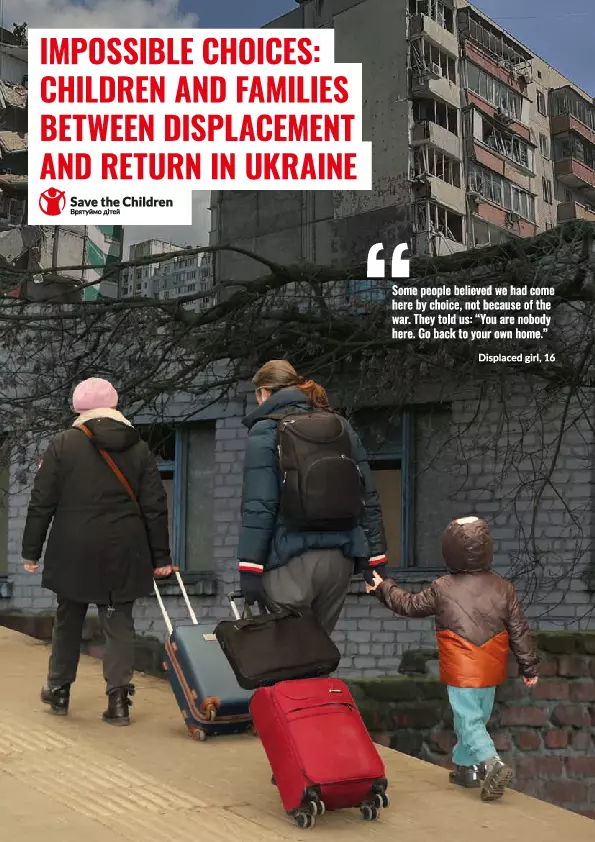
Impossible Choices: Children and Families Between Displacement and Return in Ukraine (2026)

Publication year:
2026

English

Format:
(17.1 MiB)

Publisher:
Save the Children Ukraine
Movement tracking data indicates that displaced households with children are more likely to return to frontline areas in Ukraine, often as part of cyclical return and re-displacement patterns. Save the Children’s research shows these returns are driven less by improved security and more by unsustainable social and economic conditions in displacement.
For many families, the push of economic exhaustion and social exclusion is matched by the pull of belonging, and under these constraints, community, identity and children’s desire to return become central to household choices. This underscores that social cohesion is not only a determinant of well-being, but a central driver of movements and protection outcomes. Findings from Donetsk, Kharkiv, Kherson, and Sumy regions show that children experience dual reality: restored belonging and emotional comfort in the familiarity of daily routines alongside persistent stress, insecurity, disrupted education, and a fragmented, constrained social environment. For many children, return offers important psychosocial relief while simultaneously exposing them to ongoing protection risks associated with conflict, service disruptions, and the prospect of repeated displacement.
These dynamics point to a broader failure of displacement to offer viable alternatives, and while for many Ukrainians, there is no meaningful escape from the reach and risks of ongoing war, the implications for children living in frontline areas requires a more concerted and consistent focus on family and community-based support, adaptable and geographically tailored child protection and education approaches, and a cross-cutting emphasis on social cohesion.
Read full abstract
Authors


View & Download


Document information
Publisher
Authors
Content type
Country
Region
Rights
© Author/Publisher
Found a mistake? Help us improve!
If you have noticed a document assigned to the wrong author or any other inaccuracies, let us know! Your feedback helps us keep our data accurate and useful for everyone.
 Subscribe and receive reading selections
 Save all your favorite materials for future use
 Upload research & contribute to the collection
Share

Link