
Study: Assessments
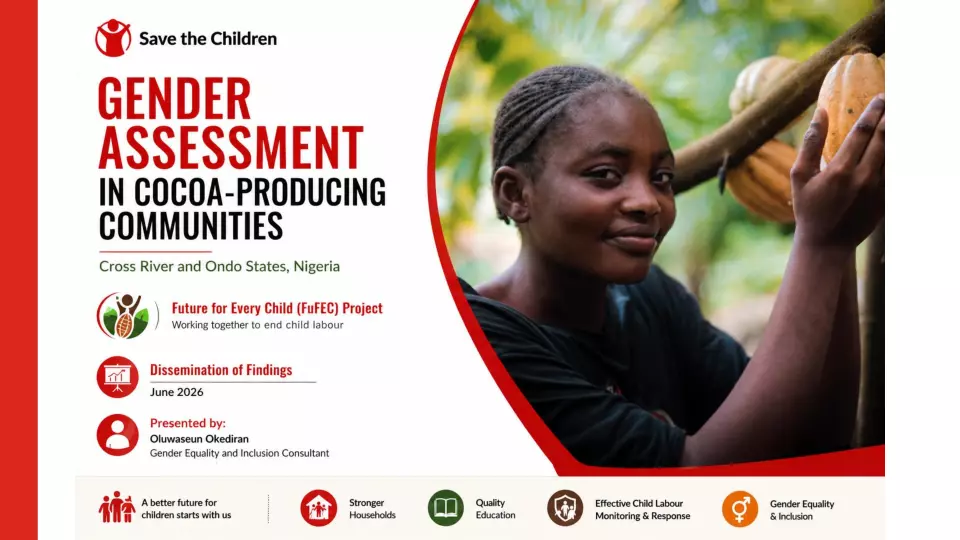
Gender Assessment in Cocoa-Producing Communities in Cross River and Ondo States, Nigeria: Findings from the Future for Every Child (FuFEC) Project

Publication year:
2026

English

Format:
(6.2 MiB)

Publisher:
Save the Children Nigeria
This gender assessment, conducted under the Future for Every Child (FuFEC) Project in cocoa-producing communities of Cross River and Ondo States, Nigeria, examined how gender inequality, household dynamics, social norms, disability, and economic pressures shape child labour, education, and protection outcomes. A mixed-methods approach was used, involving 731 household surveys, 24 focus group discussions, 13 key informant interviews, desk reviews, and direct observations across 26 communities.
Findings show that child labour is driven by interconnected factors beyond poverty, including unequal household decision-making, women’s heavy unpaid care burdens, harmful social norms, and the exclusion of vulnerable groups. Adolescent girls, children with disabilities, and migrant households face higher risks of school disruption, child labour, and limited access to services. The study also found high acceptance of violence in some communities and significant underreporting of protection concerns.
The assessment concludes that reducing child labour requires gender-transformative and inclusive programming that addresses unequal power relations, strengthens protection and accountability systems, promotes women’s agency, and improves access to services for the most vulnerable children and households. Key recommendations include strengthening child labour monitoring and referral mechanisms, expanding girl-focused interventions, increasing disability inclusion, and enhancing community-based protection systems
Read full abstract
View & Download


Document information
Publisher
Content type
Country
Region
Rights
© Author/Publisher
Found a mistake? Help us improve!
If you have noticed a document assigned to the wrong author or any other inaccuracies, let us know! Your feedback helps us keep our data accurate and useful for everyone.
 Subscribe and receive reading selections
 Save all your favorite materials for future use
 Upload research & contribute to the collection
Share

Link