
Study: Evaluations
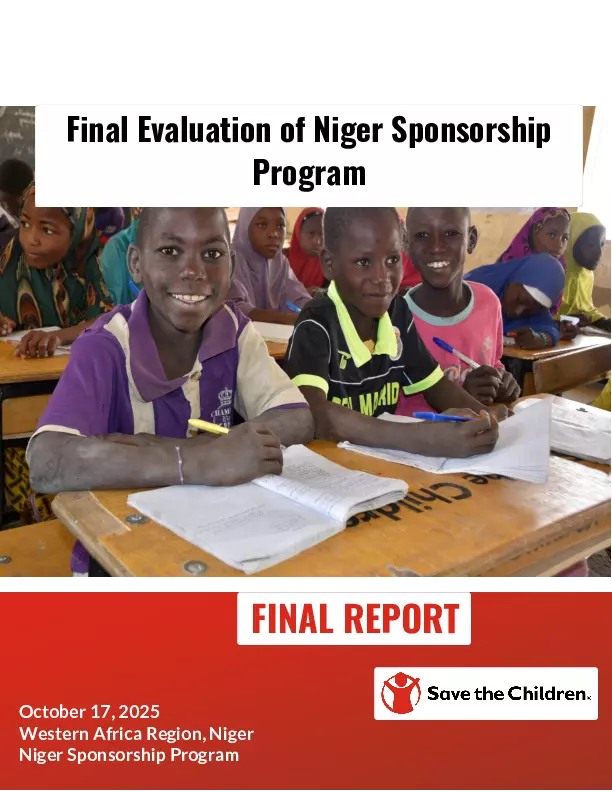
Final Evaluation of Niger Sponsorship Program (2025)

Publication year:
2025

English

Format:
(1.5 MiB)

Publisher:
Save the Children Niger
This final evaluation assesses the Niger Sponsorship Program implemented from 2017 to 2025 across 48 villages in the Aguié department of Maradi, Niger. The program aimed to ensure children are healthy, educated, and protected through integrated interventions in Early Childhood Care and Development (ECCD), Basic Education, School Health and Nutrition (SHN), and Adolescent Development, supported by cross-cutting work in gender equality, child protection, and community mobilization. Using a mixed-methods approach aligned with OECD-DAC criteria, the evaluation examined effectiveness, impact, and sustainability through IDELA assessments, literacy tests, KAP surveys, adolescent development tools, and extensive qualitative data from caregivers, teachers, adolescents, and community leaders.
Findings show substantial gains in early numeracy, socio-emotional development, foundational literacy, school safety, and adolescent economic engagement. Key improvements included a rise in IDELA numeracy scores from 44% to 75%, strong growth in socio-emotional skills, and a sharp increase in reading proficiency among primary school children (0% to 37% reaching reader level).
The program also achieved widespread WASH coverage, strengthened community protection structures, and enabled 55% of targeted adolescents to engage in income-generating activities. However, challenges persisted in early literacy development, consistent access to health services, gender and geographic disparities, and sustainability gaps due to limited government integration of program models.
Overall, the evaluation concludes that while the program generated meaningful improvements in children’s learning, health behaviours, and community capacity, structural barriers such as poverty, supply-chain limitations, and uneven service coverage constrained impact. Sustaining the program’s gains will require deeper system integration, targeted strategies for low-performing areas, and expanded support for vulnerable groups.
Read full abstract


View & Download


Document information
Publisher
Authors
Content type
Country
Region
Rights
© Author/Publisher
Found a mistake? Help us improve!
If you have noticed a document assigned to the wrong author or any other inaccuracies, let us know! Your feedback helps us keep our data accurate and useful for everyone.
 Subscribe and receive reading selections
 Save all your favorite materials for future use
 Upload research & contribute to the collection
Share

Link