Reports
Exploratory Research on Conversion Practices (Philippines, 2025)

Publication year:
2025

English

Format:
(4.2 MiB)

Publisher:
Save the Children Philippines
In the Philippines, conversion practices is a concealed concern, often veiled as corrective practices within families, religious institutions, and community settings. The practice is sustained by the country’s deeply rooted religious values, which reinforce heteronormative ideals and create social pressure for people of diverse SOGIESC to conform to traditional norms. Despite numerous studies and professional stances highlighting the negative impacts of this practice, explicit prohibitions and legal protections remain absent. The continued pervasiveness of conversion practices and the lack of mechanisms against it highlight the critical need for further action to eliminate conversion practices and promote a more affirming environment for all Filipinos.
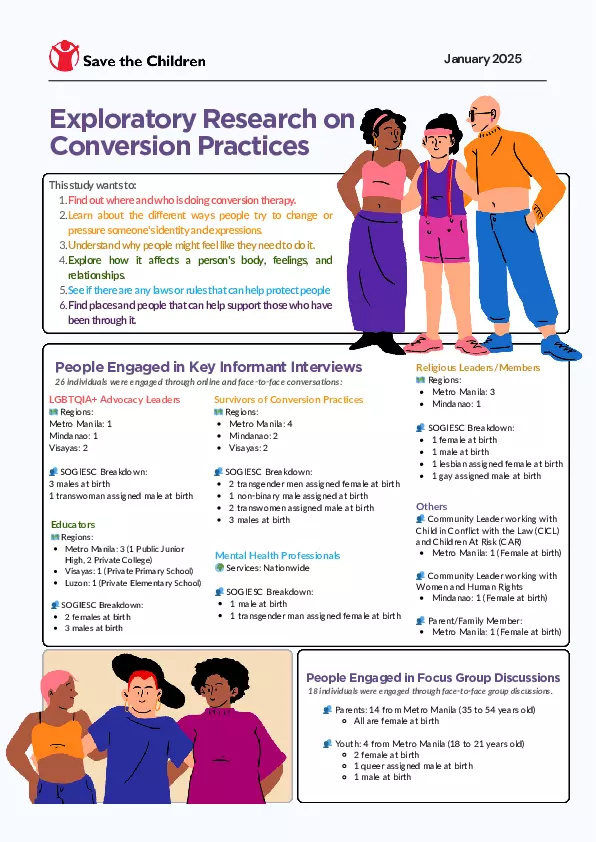
This exploratory study focused on examining the existence of conversion practices in the country, its forms, and its impacts on survivors and other stakeholders. A scoping review was conducted to explore the psychological, religious, and legislative dimensions of LGBTQIA+ experiences in the Philippines, with a focus on conversion practices as a central phenomenon. Data collection involved 17 key informant interviews and 3 focus group discussions, engaging LGBTQIA+ community leaders, survivors, mental health professionals, educators, and religious leaders. Transcripts were analyzed using inductive coding to identify themes aligned with the research objectives.
Findings show that conversion practices persist in both rural and urban settings throughout the Philippines. The practice affects individuals as young as six, but mostly with youth from the ages of 13 to 17 being the most commonly impacted group. Within the LGBTQIA+ community, those who are assigned male at birth across all age groups are more vulnerable compared to those who are assigned females at birth. . Transgender people and those from low-income communities are also vulnerable to these interventions. Conversion practices commonly takes the form of informal family-driven eff orts and church-led initiatives, with ex-gay ministries playing a prominent role in promoting and administering these practices. Forms of physical, psychological, and emotional abuse are also used to ‘rid’ individuals of their homosexuality.
Conversion practices are mainly sought due to religious beliefs, as homosexuality does not align with divine laws. Additionally, conversion practices are sought because of society’s gender normativity, systemic close-mindedness, family pressure, and the stigma that people of diverse SOGIESC experience from both their communities and intimate relationships. As a result, individuals who have undergone conversion practices report physical impacts such as exhaustion and discomfort, social impacts like difficulty trusting others and repression, and psychological impacts including self-condemnation, suicidal ideation, and substance abuse, among others.
There is an absence of a comprehensive national law to protect the rights of LGBTQIA+ individuals, leaving discrimination against them still legal. Many religious groups oppose the legislation of such a bill. However, some local government units have been drafting and implementing their own legislation to protect the rights of LGBTQIA+ people in their localities. Much advocacy work is being done to push for national legislation for the rights and recognition of all Filipino LGBTQIA+ people. In the meantime, support available to survivors comes in the form of immediate, personal, and structural resources, which are available at different levels of society.
Based on these findings, recommendations include strengthening legal advocacy and support systems, providing mental health and well-being services, promoting LGBTQIA+ awareness, and engaging with communities (religious or otherwise) for change. Moreover, alongside limitations with minors, recommendations also include carefully working with the appropriate government agencies and non-governmental organizations to provide assistance to children and minors with diverse SOGIESC.
Read full abstract
View & Download

English
1 Documents


Document information
Publisher
Content type
Country
Region
Rights
© Author/Publisher
Found a mistake? Help us improve!
If you have noticed a document assigned to the wrong author or any other inaccuracies, let us know! Your feedback helps us keep our data accurate and useful for everyone.
 Subscribe and receive reading selections
 Save all your favorite materials for future use
 Upload research & contribute to the collection
Share

Link