
Study: Evaluations
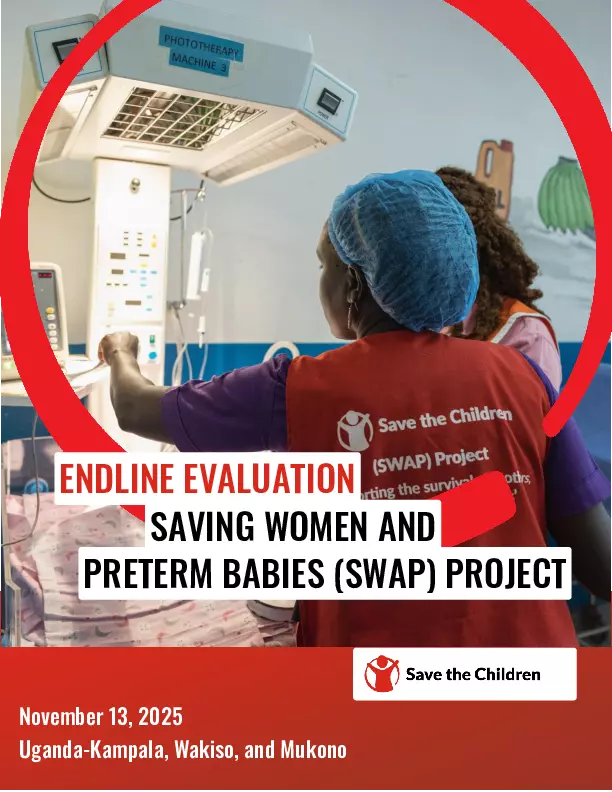
Endline Evaluation: Saving Women and Preterm Babies (SWAP) Project (Uganda, 2025)

Publication year:
2025

English

Format:
(1.8 MiB)

Publisher:
Save the Children Uganda
Maternal and newborn mortality remain major challenges in Uganda’s urban health system, prompting the Saving Women and Preterm Babies (SWAP) project to strengthen the quality of care for high‑risk pregnancies and small and sick newborns across five high‑volume facilities in Kampala, Wakiso, and Mukono. The Saving Women and Preterm Babies (SWAP) Project (2021–2025) was implemented by Save the Children in partnership with the Ministry of Health, Kampala Capital City Authority (KCCA), and District Local Governments of Wakiso, and Mukono to improve survival of pregnant women with complications and small and sick newborns in urban health facilities.
This endline evaluation assessed progress from 2021–2025 using mixed methods, revealing substantial improvements in clinical outcomes, service readiness, and provider competence. Maternal deaths due to pre‑eclampsia/eclampsia declined from 24% at baseline to 13%, while survival of newborns <1500g improved from 79% to 95% before discharge. Adoption of evidence‑based interventions-such as antenatal corticosteroids, magnesium sulphate, pPROM antibiotics, and the Vayu CPAP device-expanded significantly, with 71% of babies on CPAP successfully weaned and neonatal respiratory mortality dropping from 30% to 6%. All facilities achieved full CEmONC signal‑function readiness, and Kangaroo Mother Care coverage rose above 50%. These findings demonstrate that targeted mentorship, strengthened systems, and adaptable technologies can markedly improve maternal and newborn survival, underscoring the need for sustained government investment to preserve and scale these gains.
Read full abstract
Authors


View & Download


Document information
Publisher
Authors
Content type
Country
Region
Rights
© Author/Publisher
Found a mistake? Help us improve!
If you have noticed a document assigned to the wrong author or any other inaccuracies, let us know! Your feedback helps us keep our data accurate and useful for everyone.
 Subscribe and receive reading selections
 Save all your favorite materials for future use
 Upload research & contribute to the collection
Share

Link