Study: Evaluations
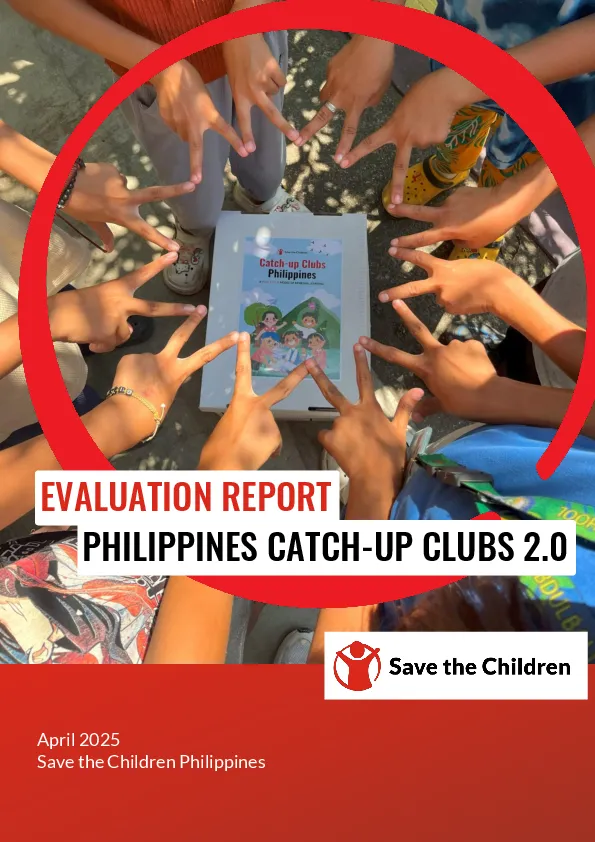
Endline Evaluation Report: Philippines Catch-up Clubs 2.0 (Philippines, 2025)

Publication year:
2025

English

Format:
(2.9 MiB)

Publisher:
Save the Children Philippines
The Catch-up Clubs (CuC) 2.0 program was implemented by Save the Children Philippines in 2024 to address severe foundational learning losses in the aftermath of the COVID-19 pandemic, which left an estimated nine out of ten Filipino children aged 10 unable to read simple texts. Building on a 2023 pilot, CuC 2.0 offered a school-led, low-cost intervention targeting struggling readers in Grades 4–6. The program combined a play-based, Teaching at the Right Level (TaRL) approach with social-emotional learning (SEL) activities and PACumustahan caregiver engagement sessions to foster supportive home learning environments.
This endline evaluation employed a mixed-methods design, using literacy assessments, the International Social and Emotional Learning Assessment (ISELA), the Perception of Parenting Styles (POPS) scale, and qualitative focus group discussions with learners, parent-leaders, facilitators, and school officials. Data were gathered from 331 learners across 15 schools in Sarangani and General Santos City.
Findings show that 63% of learners advanced by at least one literacy level, with some progressing up to four levels. Gains were strongly associated with consistent attendance and play-based instructional strategies, although 37% of learners showed no improvement due to barriers such as irregular participation, language mismatches, and limited home learning support. SEL outcomes improved across all domains, with notable progress in empathy, perseverance, and emotional regulation. Girls generally outperformed boys in literacy and empathy gains, while older learners showed stronger SEL improvements. Caregiver engagement through PACumustahan fostered awareness and emotional connection but had limited influence on children’s attendance and literacy outcomes due to work demands and social stigma.
The evaluation concludes that CuC 2.0 effectively improved literacy and SEL outcomes for many learners while highlighting persistent challenges faced by minority groups. The model demonstrates potential for integration into national programs such as the Department of Education’s National Reading Program and Bawat Bata Makababasa initiative, particularly through its TaRL-inspired grouping and play-based strategies. However, sustainability will require formal recognition, refresher training, and modest resource support for facilitators and schools. These insights highlight the program’s value as a scalable, context-sensitive approach to addressing learning poverty in the Philippines.
Read full abstract


View & Download


Document information
Publisher
Authors
Content type
Country
Region
Topics
Rights
© Author/Publisher
Found a mistake? Help us improve!
If you have noticed a document assigned to the wrong author or any other inaccuracies, let us know! Your feedback helps us keep our data accurate and useful for everyone.
 Subscribe and receive reading selections
 Save all your favorite materials for future use
 Upload research & contribute to the collection
Share

Link