
Study: Evaluations
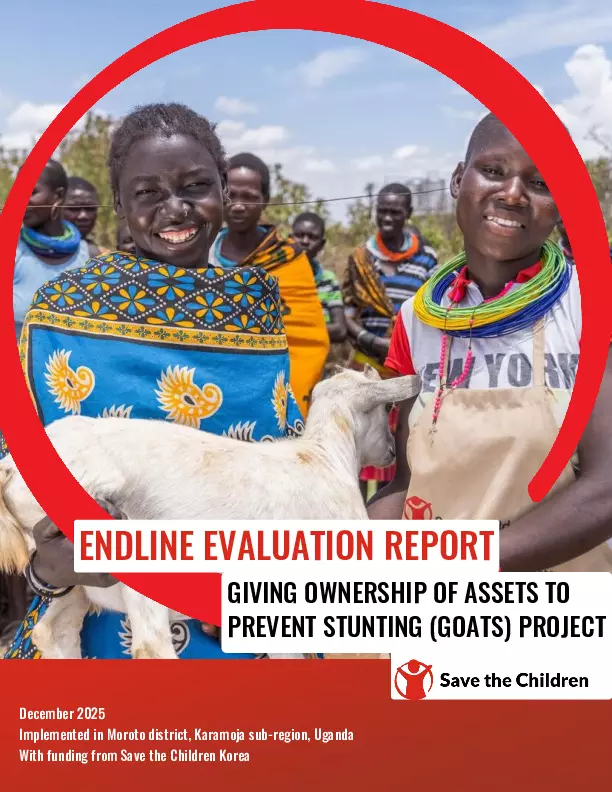
Endline Evaluation Report: Giving Ownership of Assets to Prevent Stunting (GOATS) Project in (Uganda, 2025)

Publication year:
2025

English

Format:
(1.4 MiB)

Publisher:
Save the Children Uganda
This report presents the endline evaluation of the Giving Ownership of Assets to Prevent Stunting (GOATS) Project, implemented by Save the Children Uganda in Moroto District, Karamoja Sub‑Region, from 2021 to 2025 with funding from Save the Children Korea. The project aimed to improve secure access to safe and nutritious food and reduce child stunting among agropastoral households through an integrated package of livestock asset transfer (improved goats), kitchen gardening, Village Savings and Loan Associations (VSLAs), nutrition behaviour change interventions, and capacity strengthening of community‑based service providers.
The evaluation employed a cross‑sectional mixed‑methods design, combining a household survey of 609 beneficiary households with qualitative data from 13 focus group discussions, 47 key informant interviews, and case studies. Quantitative and qualitative findings were triangulated to assess project relevance, effectiveness, sustainability, and outcomes.
Findings show significant improvements in household food security and economic resilience. The proportion of food‑secure households doubled between baseline and endline, dietary diversity increased substantially, and reliance on negative coping strategies declined. Livelihood gains were driven primarily by VSLA participation, goat ownership, and kitchen gardening. However, improvements in child nutrition outcomes were modest. While Minimum Dietary Diversity improved, progress in Minimum Acceptable Diet (MAD) among children aged 6–23 months was limited and not statistically significant, highlighting a persistent gap between household food access and optimal infant and young child feeding practices.
The evaluation concludes that integrated livelihoods and nutrition‑sensitive programming can strengthen household resilience in fragile agropastoral contexts, but asset‑based interventions alone are insufficient to improve child nutrition. Sustained, gender‑sensitive behaviour change, stronger veterinary systems, simplified asset models, and longer‑term programming are recommended to translate livelihood gains into lasting nutrition outcomes and sustain impact beyond the project lifecycle.
Read full abstract


View & Download


Document information
Publisher
Authors
Content type
Country
Region
Topics
Rights
© Author/Publisher
Found a mistake? Help us improve!
If you have noticed a document assigned to the wrong author or any other inaccuracies, let us know! Your feedback helps us keep our data accurate and useful for everyone.
 Subscribe and receive reading selections
 Save all your favorite materials for future use
 Upload research & contribute to the collection
Share

Link