Study: Evaluations
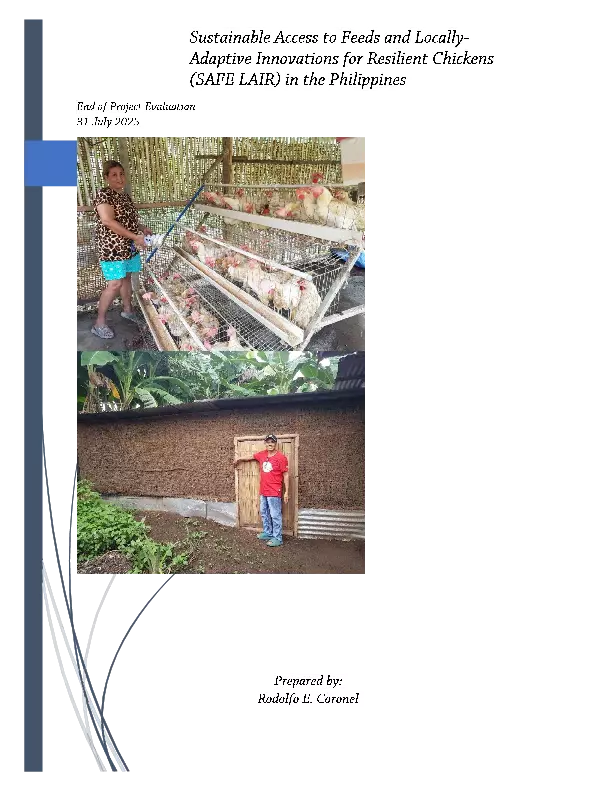
End of Project Evaluation: Sustainable Access to Feeds and Locally Adaptive Innovations for Resilient Chickens (SAFE LAIR) in the Philippines (2025)

Publication year:
2025

English

Format:
(10.1 MiB)

Publisher:
Save the Children Philippines
The Sustainable Access to Feeds and Locally Adaptive Innovations for Resilient Chickens (SAFE LAIR) Project was found to be highly responsive to the needs of participating households in Barangays Anastacia and San Pedro, Tiaong, Quezon. The project successfully enhanced household income, improved family nutrition, and promoted sustainable livelihood practices through small-scale poultry production.
By design and implementation, the project achieved its intended objectives of increasing family income, ensuring steady access to eggs and chicken meat for household nutrition, and promoting local innovation in climate-resilient poultry management. Families reported that proceeds from egg and chicken sales were used to support daily household expenses, particularly for children’s schooling—covering allowances, transportation, and school projects. The availability of eggs and meat also helped ensure that no child went to school hungry.
Capacity-building activities—including trainings, seminars, and workshops—proved valuable not only in developing technical knowledge on poultry management and organic agriculture but also in building life skills, confidence, and empowerment, especially among women and children. These learning sessions fostered stronger social networks, community collaboration, and camaraderie among participants and stakeholders. The project also encouraged gender equality and shared household responsibilities, transforming family dynamics toward more cooperative and nurturing relationships.
Implementation was inclusive and participatory, engaging 92 family beneficiaries along with local government units, Farmers Associations (FAs), the Local Monitoring Team (LMT), and other local structures. Coordination, transparency, and accountability were strengthened through the establishment of a GroupChat system and community-based monitoring mechanisms. The project’s design also integrated a Child Rights-Based Approach (CRBA), ensuring that children were not only beneficiaries but active participants in improving their families’ welfare.
The project demonstrated strong alignment with national and local priorities on food security, poverty alleviation, and sustainable livelihoods. It introduced innovative, low-cost solutions such as formulated feeds using local materials and protective poultry shelters that reduced chicken morbidity and mortality, ultimately improving productivity and profitability. Quantitative and qualitative evidence indicate a very high level of satisfaction among beneficiaries, with nearly all respondents affirming that the project met their economic and nutritional needs. On average, households earned ₱3,660 per month from egg and chicken sales, providing a significant boost to family income.
In conclusion, the SAFE LAIR Project was effective, efficient, and impactful. It not only enhanced household income and food security but also strengthened family relationships, promoted women’s empowerment, and improved children’s well-being. The project’s participatory design, inclusive implementation, and innovative climate-resilient approaches offer a promising and replicable model for sustainable rural livelihoods that can be scaled up to benefit more farming communities across the Philippines.
Read full abstract


View & Download


Document information
Publisher
Authors
Content type
Country
Region
Rights
© Author/Publisher
Found a mistake? Help us improve!
If you have noticed a document assigned to the wrong author or any other inaccuracies, let us know! Your feedback helps us keep our data accurate and useful for everyone.
 Subscribe and receive reading selections
 Save all your favorite materials for future use
 Upload research & contribute to the collection
Share

Link