
Briefs, Fact Sheets and Brochures, Policies, Standards, and Strategies, Reports
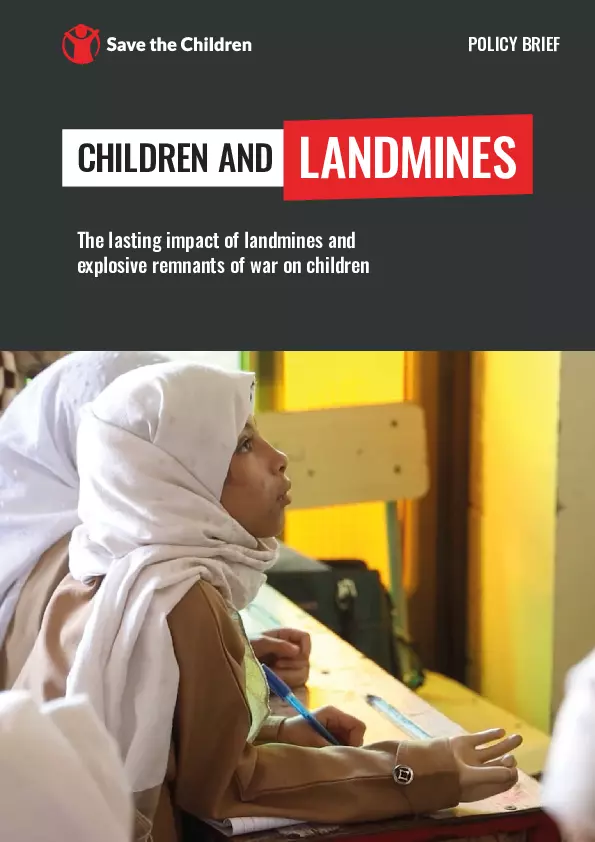
Children and Landmines: The Lasting Impact of Landmines and Explosive Remnants of War on Children

Publication year:
2026

English

Format:
(2.6 MiB)

Publisher:
Save the Children UK
Landmines and explosive remnants of war continue to kill and injure children long after fighting ends, while new contamination is accumulating across active conflicts. This policy brief examines the scale and lasting impact of landmines, unexploded ordnance, cluster munition remnants and other explosive ordnance on children.
Between 2020 and 2025, at least 12,053 children were verified as killed or injured by explosive ordnance – one in every five children killed or injured in armed conflict during this period – and children represented 46% of civilian landmine and ERW casualties in 2024 where age was known.
Drawing on case studies from seven conflict contexts — Afghanistan, Iraq, Yemen, Syria, Myanmar, Ukraine and the occupied Palestinian territory — the brief shows two intersecting patterns: legacy contamination continuing to harm children decades after fighting subsides, and new contamination accumulating faster than it can be surveyed and cleared, particularly as displaced families return and reconstruction begins.
The brief highlights rising contamination, weakening international norms and declining mine-action funding, and calls for stronger treaty implementation, predictable multi-year funding for clearance, explosive-ordnance risk education and victim assistance, and lifelong support for child survivors.
Read full abstract


View & Download


Document information
Publisher
Authors
Country
Topics
Rights
© Author/Publisher
Found a mistake? Help us improve!
If you have noticed a document assigned to the wrong author or any other inaccuracies, let us know! Your feedback helps us keep our data accurate and useful for everyone.
 Subscribe and receive reading selections
 Save all your favorite materials for future use
 Upload research & contribute to the collection
Share

Link