Study: Assessments
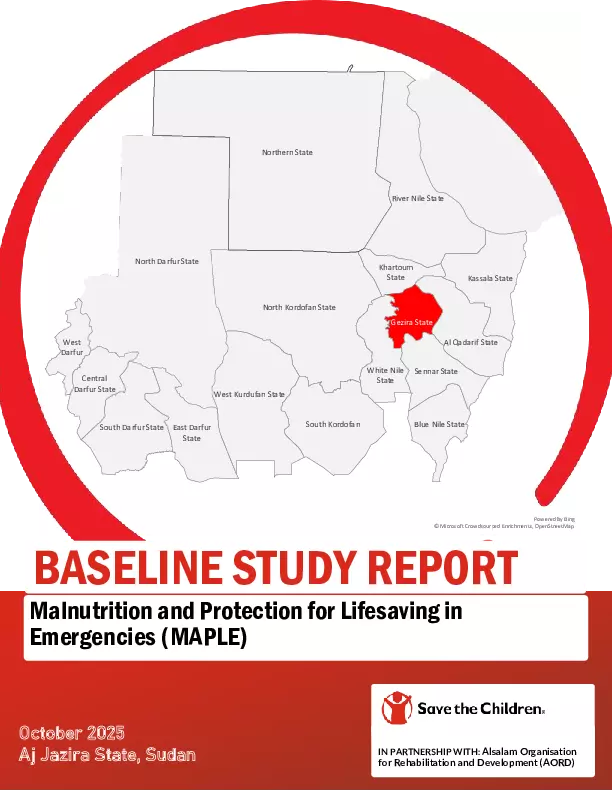
Baseline Study Report: Malnutrition and Protection for Lifesaving in Emergencies (MAPLE) (Sudan, 2025)

Publication year:
2025

English

Format:
(1.3 MiB)

Publisher:
Save the Children Sudan
This baseline study establishes benchmark values for the Malnutrition and Protection for Lifesaving in Emergencies (MAPLE) project implemented by Save the Children International in partnership with Alsalam Organisation for Rehabilitation and Development (AORD) in El Manageel and Madani El Kobra localities of Aj Jazira State, Sudan. Funded by Global Affairs Canada (GAC), the project aims to improve nutrition, health, water, sanitation and hygiene (WASH), and protection outcomes for crisis-affected children and women through an integrated, gender-responsive humanitarian approach.
The study employed a mixed-methods, cross-sectional design comprising quantitative household surveys with 185 caregivers of children under five years and 186 children and adolescents aged 10–18 years, complemented by assessments of health facilities and child protection service providers. Participants were selected using probability-based systematic random sampling, and data were collected in August 2025 using standardized digital tools administered through Kobo. Descriptive statistical analysis and qualitative thematic analysis were conducted to establish baseline values for key project indicators.
The findings indicate that breastfeeding practices are generally strong, with high levels of early initiation and exclusive breastfeeding, although important gaps remain in complementary feeding practices and dietary diversity. The assessment also identified persistent protection concerns, including risks of sexual and gender-based violence, limited awareness and utilization of protection and referral services, and constraints in the capacity of health and child protection systems to deliver integrated, survivor-centred services. Contextual factors such as displacement, insecurity, gender norms, and limited access to essential health, nutrition, WASH, and protection services continue to undermine child and caregiver well-being.
The study provides critical baseline evidence to guide project implementation, refine targeting strategies, and monitor progress toward improved nutrition and protection outcomes. It recommends strengthening integrated service delivery, expanding community-based behaviour change interventions, enhancing referral and case management systems, building the capacity of frontline service providers, and promoting equitable access to quality nutrition, health, WASH, and protection services throughout the project period.
Read full abstract
View & Download


Document information
Publisher
Content type
Country
Region
Topics
Rights
© Author/Publisher
Found a mistake? Help us improve!
If you have noticed a document assigned to the wrong author or any other inaccuracies, let us know! Your feedback helps us keep our data accurate and useful for everyone.
 Subscribe and receive reading selections
 Save all your favorite materials for future use
 Upload research & contribute to the collection
Share

Link