
Briefs, Fact Sheets and Brochures
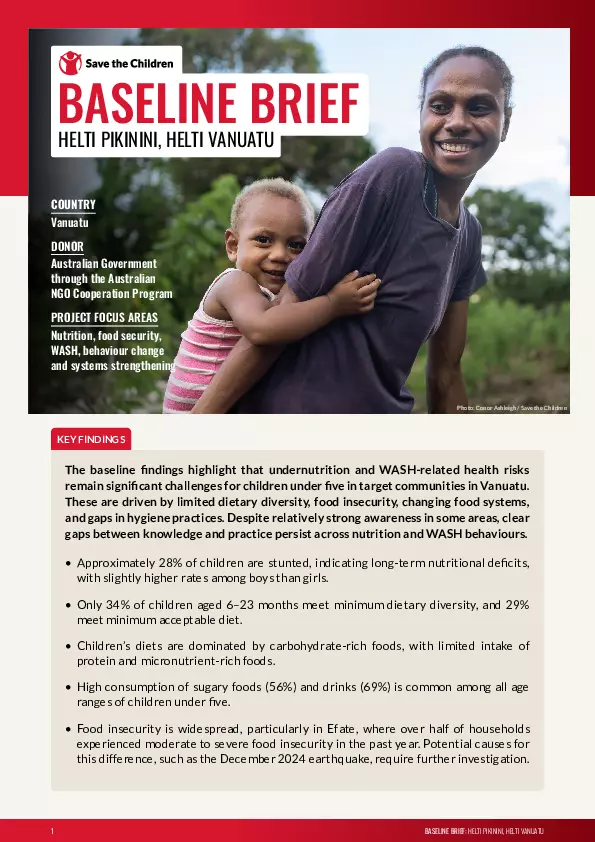
Baseline Brief: Helti Pikinini, Helti Vanuatu Project in Australia

Publication year:
2026

English

Format:
(2.1 MiB)

Publisher:
Save the Children Australia
This baseline study was conducted for Save the Children’s Helti Pikinini, Helti Vanuatu (HPHV) project, a four-year Australian NGO Cooperation Program (ANCP)-funded initiative that aims to reduce undernutrition and WASH-related health risks among children aged 0-5 years in Sanma and Shefa Provinces, Vanuatu. The study established benchmark values for key project indicators and generated evidence on child nutrition, food security, water, sanitation and hygiene (WASH), caregiving practices, and the enabling environment to inform programme implementation and future monitoring. A mixed-methods approach was used, including household surveys with 595 caregivers of children under five, key informant interviews, market observations, and a barrier analysis.
The findings show that undernutrition remains a significant challenge, with 28% of children under five stunted. While minimum meal frequency was relatively high (83%), only 34% of children aged 6-23 months met minimum dietary diversity and 29% met the minimum acceptable diet. Children’s diets were dominated by carbohydrate-rich foods, with limited consumption of nutrient-rich foods, while consumption of sugary foods and drinks was common. Food insecurity was prevalent, affecting one-third of surveyed households and over half of households in Efate. Twenty Vatu markets play an important role in household food access but often provide limited dietary diversity and face food hygiene constraints.
WASH access varied considerably across communities. While 54% of households used improved drinking water sources and 83% had improved sanitation facilities, significant gaps were identified in hygiene infrastructure and behaviours. Only 37% of households had an observed handwashing station, and key misconceptions around water treatment and hygiene practices persisted. The study also identified low exposure to nutrition promotion, limited developmental screening for children, and a substantial gap between knowledge and practice across nutrition and WASH behaviours. Practical constraints such as food affordability, time pressures, and household responsibilities often limited behaviour change.
The baseline highlights the need for integrated interventions that combine nutrition, food security, WASH, behaviour change, youth engagement, and systems strengthening. Key priorities include expanding social and behaviour change communication, improving dietary diversity, strengthening market-based nutrition approaches, addressing WASH behaviour gaps, increasing child development services, and supporting community and government systems to sustain improved outcomes for children
Read full abstract
View & Download

English
1 Documents


Document information
Publisher
Content type
Country
Region
Topics
Rights
© Author/Publisher
Found a mistake? Help us improve!
If you have noticed a document assigned to the wrong author or any other inaccuracies, let us know! Your feedback helps us keep our data accurate and useful for everyone.
 Subscribe and receive reading selections
 Save all your favorite materials for future use
 Upload research & contribute to the collection
Share

Link