Best Practices/Lessons Learned, Briefs, Fact Sheets and Brochures
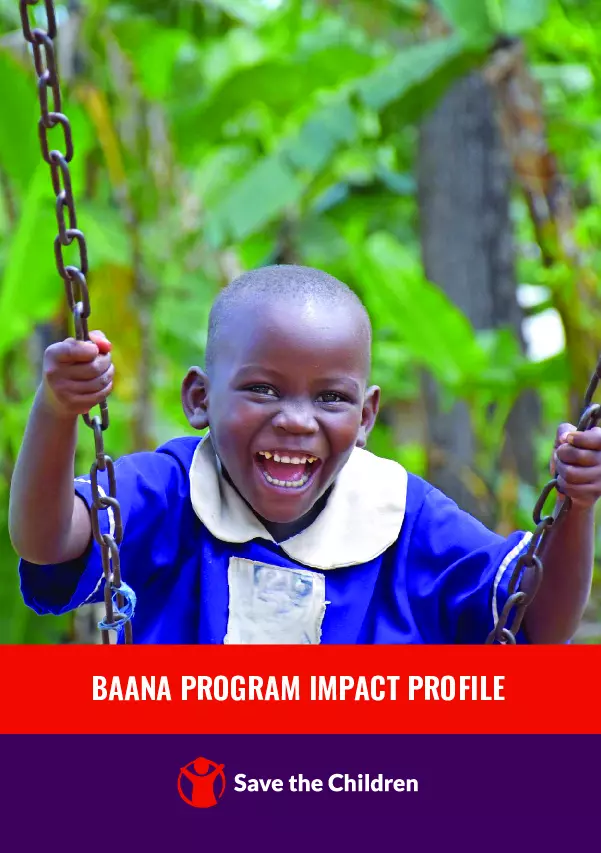
Baana Sponsorship Program Impact Profile (2014–2026) (Uganda, 2026)

Publication year:
2026

English

Format:
(8.9 MiB)

Publisher:
Save the Children Uganda
Children in Uganda continue to face interconnected challenges that affect their health, learning, protection and future opportunities. In response, the Baana Sponsorship Program implemented by Save the Children Uganda worked with children, families, schools, communities and local government structures between 2014 and 2026 to improve child well-being and strengthen the systems that support children to survive, learn, be protected and thrive. Reaching an average of 135,505 children annually in 82 primary schools, 55 ECCD Centres, 23 health facilities in the districts of Wakiso, Kikuube and Kamwenge, the programme implemented integrated interventions across early childhood development, education, child protection, health and nutrition, adolescent development, and household economic strengthening. This impact profile presents evidence from twelve years of programme implementation in Uganda. Using programme monitoring data, outcome evaluations and tracer studies, the profile documents achievements and sustained outcomes across early childhood care and development, basic education, child protection, school health and nutrition, adolescent development, livelihoods and community mobilisation.
The programme delivered measurable improvements across all areas of child well-being. More children accessed quality early learning opportunities, with ECCD annual enrolment in supported ECCD centres increasing from 2,720 to 3,615 children and average IDELA scores increasing from 47% to 73%, indicating substantial gains in school readiness and child development. Basic education outcomes improved with the proportion of schools meeting national quality standards doubling from 42% to 85%, literacy levels among Grade 3 learners increasing from 8% to 29%, numeracy from 30% to 49%, and Primary Leaving Examination pass rates rising from 41% to 95.5%. Child protection systems were strengthened through the training of 105 para-social workers, with 97% of children reporting awareness of safeguarding measures and up to 73% reporting that they felt safe at school. Investments in school health and nutrition increased the proportion of schools with handwashing facilities from 70.4% to 93% and the proportion of children observed practising handwashing at critical times from 44.4% to 92.6%. Adolescent development interventions improved accurate knowledge of sexual and reproductive health topics from 41% to 71.7%, while confidence in seeking SRH information and services increased from 80% to 90.9%. At household level, families became more resilient, with diversified income sources increasing from 50% to 86%, acceptable food consumption rising from 64% to 98%, and 120 Village Savings and Loan Associations established to strengthen economic security.
Tracer study findings indicated that programme benefits were sustained beyond direct support, with 98% of former ECCD graduates (2018, 2019, 2022 cohorts) progressing to and remaining in primary school, 87% of former primary school graduates (2022, 2023, 2024 cohorts) transitioning to secondary education, and 98.1% of former beneficiaries continuing in education (including vocational training). Former participants also demonstrated sustained gains in learning, life skills and aspirations, while community-based structures established by the programme, including child protection mechanisms, savings groups and parenting support structures, remained functional and continued to provide services beyond the programme period, demonstrating the sustainability of investments made in children, families and local systems.
Read full abstract


View & Download

English
1 Documents


Document information
Publisher
Authors
Country
Region
Topics
Rights
© Author/Publisher
Found a mistake? Help us improve!
If you have noticed a document assigned to the wrong author or any other inaccuracies, let us know! Your feedback helps us keep our data accurate and useful for everyone.
 Subscribe and receive reading selections
 Save all your favorite materials for future use
 Upload research & contribute to the collection

Share

Link